
By pittsburgh-merchantservices October 1, 2025
Pittsburgh’s business landscape is a fascinating blend of legacy industries and modern entrepreneurship. From the steel city’s manufacturing DNA to today’s robotics, healthcare, higher education, and thriving food-and-beverage scene, the region supports a wide range of merchant profiles—each with distinct payment needs.
If you run a small café in Lawrenceville, a mobile food truck that rotates through North Shore game days, a boutique on Walnut Street in Shadyside, or a contractor serving the South Hills, the right merchant services partner directly impacts your cash flow, customer experience, and operating costs. This isn’t just about “taking cards.”
It’s about accepting the ways people want to pay—tap, chip, QR, wallet, pay-by-link, invoice—and doing it securely, transparently, and at a cost that fits your margins. It’s also about support that understands local realities: weekend festivals on the North Side, market days in Strip District, seasonal rushes during university move-in, and event surges around PPG Paints Arena and Acrisure Stadium.
Choosing a provider can feel overwhelming because pricing models, contract structures, and feature bundles vary widely. Some providers emphasize low advertised rates but layer fees in confusing statements.
Others tout sleek hardware but lock you into long contracts or early termination penalties. There are providers that shine at eCommerce and invoicing but stumble with in-person tipping, dual-pricing signs, or cash-discount rules.
The Pittsburgh twist is that many businesses blend channels—foot traffic, phone orders, curbside pickup, and online preorders—so you want a partner that can unify these flows into one system. That means one payout schedule, one set of reconciliations, and one support desk to call when something breaks before a big game or during the holiday rush.
A good provider also helps you future-proof. Payments evolve quickly: EMV tap-to-pay on iPhone/Android, Pay by Bank/ACH, Buy Now Pay Later, surcharging/dual pricing programs, and real-time settlement options are all entering the mainstream.
Meanwhile, compliance and security—from PCI to chargeback management to fraud controls—become more complex. The right partner makes complexity feel simple, clarifies risks, and shows you the trade-offs when you change pricing strategies or add new channels.
Finally, the right choice should reflect your business identity. A locally oriented partner might bring on-site setup, same-day hardware swaps, or in-person training.
A national processor might offer deeper software marketplaces, advanced APIs, and broad eCommerce features. Neither is inherently “better.” The best fit is the one that matches your sales patterns, team, tech stack, and growth plan in Pittsburgh’s dynamic market.
How to Evaluate Merchant Service Providers (Pricing, Contracts, and Total Cost)
Pricing isn’t just a headline rate. It’s a system. In Pittsburgh, where margins can be tight for restaurants and retail, small differences in your effective rate compound quickly.
Start with the three dominant pricing models: interchange-plus, flat-rate, and tiered/bundled. Interchange-plus is usually the most transparent: you pay the card network’s interchange plus a disclosed markup (e.g., basis points and per-transaction fee).
Flat-rate models (e.g., a single percent plus a few cents) are simple and predictable, often good for very small tickets or low volume, but can cost more as you scale.
Tiered/bundled plans group transactions into “qualified,” “mid-qualified,” and “non-qualified” buckets—these can be opaque and unpredictable, especially if rewards or corporate cards push many transactions into higher-cost tiers.
For most established Pittsburgh SMBs, interchange-plus or a well-explained flat-rate plan will be easier to audit.
Next, scrutinize non-processing fees. Common line items include monthly account fees, PCI compliance fees, statement fees, gateway fees, batch fees, and chargeback fees. Ask providers to share a sample statement and map every fee to a definition.
If they can’t explain a fee in clear, non-technical language, treat it as a red flag. Also check hardware costs: will you buy terminals upfront, lease, or finance? Leasing terminals often look affordable month-to-month but can be the most expensive route over the contract term.
Clarify replacement policies for damaged devices—high-traffic venues near stadiums and pop-up vendors at festivals may need rugged units, spare batteries, and rapid swap options.
Contract terms matter. Avoid long-term commitments with automatic renewals and early termination fees (ETFs) unless you’re compensated via discounted rates or subsidized hardware that you actually need.
Month-to-month contracts offer flexibility, which is valuable in seasonal markets. If a provider requires a term, negotiate clear exit paths, device unlocks, and data portability (customer tokens, recurring billing profiles, and stored cards should remain yours).
Ask about funding timelines—most merchants in Pittsburgh are comfortable with next-business-day funding, but some providers can offer same-day or even instant options for a fee. Understand cutoff times, weekend/holiday funding, and exceptions during bank closures or severe weather events that can disrupt schedules.
Finally, calculate Total Cost of Acceptance (TCA). Don’t just compare headline rates. Model real volumes and ticket sizes by tender type (credit, debit/regulated debit, keyed, contactless wallets). Factor in chargebacks and refunds.
Include hardware depreciation, software subscriptions (POS, inventory, staff scheduling, loyalty), and the internal time you spend on reconciliations and support calls. If you can, request a free statement analysis.
A strong provider will translate your current statement into an apples-to-apples comparison and show you annualized savings, along with any trade-offs. The goal isn’t always “cheaper.” Sometimes paying a bit more for better reporting, faster funding, or reliable local support saves you money and headaches over the long run.
Pittsburgh-Focused Capabilities: What Local Businesses Ask For Most

Pittsburgh’s neighborhoods and event calendar create unique operational patterns. Restaurants, bars, and coffee shops near university districts (Oakland, Squirrel Hill) see student-driven peaks and demand for split checks, tip prompts, and QR ordering.
Providers that support flexible tipping, table/seat mapping, and offline mode (for spotty Wi-Fi in older buildings or crowded events) will outperform generic card readers. If you run a food truck at the Strip District or the Three Rivers Arts Festival, look for mobile-first POS, hotspot-friendly setups, and quick-swap batteries.
For medical, dental, and wellness clinics connected to Pittsburgh’s healthcare ecosystem, prioritize card-on-file, invoice links, HSA/FSA acceptance, and recurring billing with automated reminders and failed-payment dunning.
Retailers serving game-day crowds around the North Shore benefit from high-throughput contactless acceptance and inventory sync between online and in-store. A provider with omnichannel tools—same product catalog in POS and eCommerce, unified order history, and consistent taxes/discounts—reduces confusion for staff and customers.
For contractors and home services in the South Hills or North Hills, field payments matter: text-to-pay links, email invoices, or tap-on-phone can speed collections and reduce unpaid jobs. If you’re a brewery or distillery hosting events, look for age verification flows, digital tabs, and easy portable terminal pooling so you can flex lanes as lines grow.
Nonprofits and schools need donation pages, one-time and recurring gifts, and cost-effective ACH to minimize fees.
Security and compliance requirements also have local texture. Many Pittsburgh businesses rely on dual pricing (cash discount vs. card price) or surcharging to offset costs. You’ll want a provider that configures these programs correctly, supplies compliant signage, and calculates net effective rates precisely.
If you sell online or run curbside pickup, ensure your provider supports tokenization, 3D Secure/step-up verification, and robust fraud rules to limit chargebacks—especially during peak seasons when order volume surges.
PCI scope reduction (via point-to-point encryption and payment tokenization) eases your compliance burden. And given the region’s mix of legacy buildings and new developments, look for hardware that handles older Ethernet drops, Wi-Fi, and LTE failover. That resilience becomes a lifesaver during storms or venue congestion.
Lastly, prioritize reporting and reconciliation. Many Pittsburgh SMBs work with local accountants or bookkeepers who want clean exports to QuickBooks or other general ledgers. A solid merchant platform will give you daily deposit summaries, fee breakdowns, and dispute dashboards.
If you manage multiple locations—say, a downtown storefront and a pop-up in Lawrenceville—ask about hierarchical reporting, role-based permissions, and per-location fee tracking. The provider that helps you close the books faster each month often pays for itself.
Comparing Provider Types: Local ISOs/Agents vs. National Processors vs. Software-Led Platforms
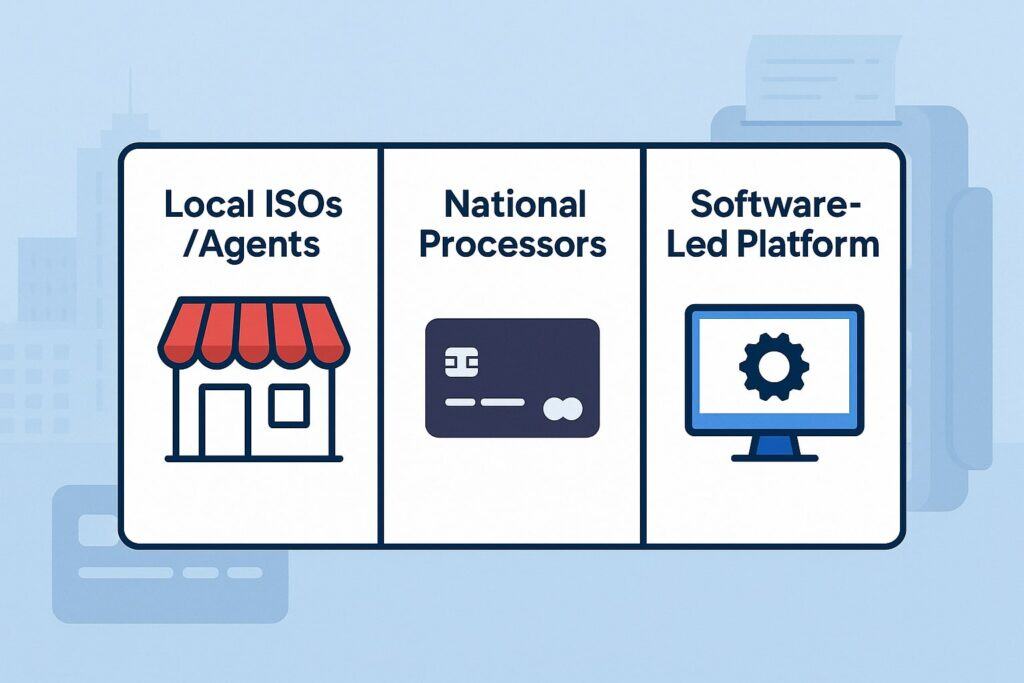
When people say “top merchant service providers,” they often lump very different companies together. In practice, you’ll encounter three archetypes, each with strengths and trade-offs. Local ISOs/agents (independent sales organizations) offer relationship-driven service.
In Pittsburgh, that can mean an on-site demo, weekend installation, and a familiar contact who picks up the phone when your line goes down during a rush. They usually provide interchange-plus pricing and can source a wide range of terminals and POS systems (from countertop to handhelds to kitchen printers).
The trade-off is that product roadmaps and software ecosystems may be more fragmented. You’ll want to confirm how updates, app integrations, and eCommerce tie-ins work, and who owns the support ticket when multiple vendors are involved.
National processors bring scale: broad card brand certifications, deep risk tooling, and sophisticated funding operations. They often provide integrated gateways, recurring billing, robust APIs, and token vaults that work across in-person and online channels.
If you need advanced features—installment options, multiple MIDs, complex routing, or high-volume performance—nationals can shine. But they may lean on generalized support queues and standard-issue contracts.
Watch for early termination fees, auto-renew clauses, and bundled software you may not need. If you go national, push for a designated account manager and clear SLAs, and make sure hardware choices align with your environment (older buildings, limited counter space, or mobile-first setups).
Software-led platforms (POS-first or eCommerce-first) win with user experience and tight integration: inventory, loyalty, gift cards, online ordering, and analytics live in one dashboard. For a café near CMU or a boutique in the South Side, that can be transformative—staff training is faster, and owners get real-time insights.
The trade-off is that payment processing may be “tied” to the software. Rates can be competitive but less negotiable, and switching later can be painful if your catalog, customer profiles, and loyalty are locked in.
Confirm export options, data ownership, and whether you can switch processors without replacing your entire system. If you plan to blend multiple front-ends (for example, a restaurant POS plus a separate event ticketing site), check that the platform’s gateway supports multi-origin tokenization and unified reporting.
A practical approach for Pittsburgh merchants is to shortlist one candidate from each archetype and run a like-for-like comparison on:
(1) effective rates on your last three months of statements, (2) contract flexibility, (3) funding speed and cutoffs, (4) hardware lifecycle and swap program, (5) omnichannel capabilities and integrations, and (6) local/on-site support commitments.
Score them against your real workflows—opening/closing procedures, menu edits, inventory receiving, staff turnover—and not just a glossy demo. The “top” provider for your neighbor might not be the best for you if your tickets, channels, and seasonality are different.
Essential Features Pittsburgh Merchants Should Prioritize (POS, Hardware, and Omnichannel)
Start with payment acceptance breadth: EMV chip, NFC/contactless (Apple Pay, Google Pay), magstripe fallback, keyed entry for phone orders, ACH where appropriate, and invoice links for B2B or home services. Layer in tap-to-pay on phone for pop-ups, delivery, and line-busting.
For hospitality, demand guest-facing tip prompts, easy tip adjust, and pre-auth for bar tabs. For retail, ensure barcode scanning, inventory variants, sku-level discounts, and integrated label printing.
If you sell online, your POS should sync products, pricing, taxes, and gift card balances with your eCommerce platform so customers experience a consistent brand regardless of channel.
Hardware considerations are practical in Pittsburgh’s built environment. Counter space in older storefronts is precious; opt for compact terminals with built-in receipt printers or lightweight handhelds for curbside and patio service.
Restaurants need kitchen impact printers or KDS screens that withstand heat and spills. Mobile vendors should consider LTE-enabled readers with good battery life and weather resistance.
Ask providers about multi-lane scalability for game-day surges, offline mode to keep lines moving when Wi-Fi hiccups, and device management for remote updates across multiple locations. A good provider will also advise on ADA-friendly setups and customer flows that reduce wait times.
Omnichannel is no longer optional. Customers expect to order ahead, pick up curbside, and earn or redeem loyalty whether they’re online or at your register. Look for centralized customer profiles, order history, store credits, and gift cards that work across channels.
Verify support for local delivery, in-store pickup windows, and waitlist/table management. For services, ensure estimate-to-invoice flows, progress billing, and stored cards for recurring charges.
And don’t forget back office: you want sales by hour/day, product mix, staff performance, margin reports, and simple exports to accounting. If a provider can’t produce clean deposit reconciliation (sales minus refunds minus fees equals bank deposit), your month-end will be a slog.
Security and compliance should be foregrounded, not bolted on. Point-to-point encryption (P2PE), tokenization, and PCI scope reduction lower risk and audit burden. Fraud tools—AVS, CVV checks, velocity limits, 3D Secure—protect online orders, which is especially important during holiday gift runs or big event weekends.
Finally, review data ownership and portability. You should be able to export your catalog, customers, and transaction data if you ever switch providers. The best partners are confident enough in their service to make leaving painless—even if you never do.
Advanced Pricing Strategies: Dual Pricing, Surcharging, and Cash Discount Programs
For many Pittsburgh businesses, especially in F&B and convenience retail, dual pricing or surcharging can help offset rising card costs. These programs require careful implementation to stay compliant and keep customers happy.
Dual pricing displays a cash price and a card price; the customer chooses. Surcharging adds a fee to credit (not debit) transactions to cover processing. A compliant provider will handle card brand rules, disclosures/signage, and receipt notation automatically.
They’ll also train your staff to explain the program in simple language—“We offer a cash price and a card price; you choose what’s best for you”—minimizing pushback at the counter.
Run the numbers before you switch. If your average ticket is low (e.g., a $6 coffee and pastry), a per-transaction add-on might feel disproportionate to customers. If your mix is corporate cards or rewards-heavy, dual pricing can materially improve your margins.
Remember, these programs are not just “turn on and forget.” Monitor conversion rates, tips, and average tickets after you enable them. If you see tip averages fall or basket sizes shrink, test different prompts or signage placement.
Some merchants blend strategies: they maintain standard prices but offer ACH or cash incentives for large invoices, which works well for contractors and B2B sellers.
Transparency is key. Publish your policy on your website, on door/checkout signs, and on receipts. For online orders, ensure the fee presentation appears before checkout completion and is itemized. Consider loyalty rewards or member pricing to soften the impact for regulars—Pittsburgh is a neighborhood city; relationships matter.
Finally, revisit the program quarterly. Card brand rules evolve, and your customer base may shift with student calendars or event seasons. A great merchant services partner will share performance analytics and recommend fine-tuning instead of leaving you to guess.
Implementation and Onboarding: From Application to First Live Transaction
Getting live should be orderly and fast. A strong Pittsburgh-focused provider will start with a needs assessment: business model, average ticket, peak hours, network setup, and any special requirements (age verification, weigh scales, kitchen printing, or campus delivery).
Your application will collect business documents—EIN, voided check, ownership info—and a KYC check will run behind the scenes. Ask for a clear timeline: approval, hardware shipment or setup appointment, and your go-live checklist. If you’re switching providers, plan a parallel run for a day to test transactions and printers before you fully cut over.
Installation should include network testing (Ethernet/Wi-Fi/LTE), receipt/kitchen printer pairing, and a walkthrough of your menu or catalog build. For restaurants, import your menu with modifiers, printer routing, and tax/tip rules.
For retail, import SKUs, variants, and barcodes; test scanning speed. For service businesses, configure invoice templates, deposit schedules, and saved payment methods. Make sure your refunds, voids, tips, and settlement batches run correctly.
Train staff on tip prompts, split tenders, and offline mode. For eCommerce, test guest checkout, account creation, gift cards, discount codes, and order notifications. If you use accounting or inventory tools, validate your data sync end-to-end—sale to payout to reconciliation.
Post-launch, monitor the first week closely. Review daily deposits, fee details, and any chargeback alerts. Confirm that same-day or next-day funding matches expectations. Keep a runbook: how to reprint receipts, re-pair a printer, swap a terminal, or reach Tier 2 support after hours.
The best providers in Pittsburgh will give you a local contact plus a 24/7 support line, offer loaner devices when something fails, and proactively check in after big events (home openers, graduation weekends, holiday parades). A thoughtful onboarding sets the tone for a long, low-stress relationship.
Common Mistakes Pittsburgh Merchants Make—and How to Avoid Them
Chasing the lowest headline rate without modeling total cost is the classic trap. An extra monthly fee here, a gateway charge there, and opaque downgrades can erase paper savings. Always request a side-by-side statement analysis.
Another mistake is locking into long hardware leases for terminals you could buy outright in a few months. Leasing can be useful in specific cases, but do the math and read the fine print—fees don’t always stop after you’ve paid the device’s retail value.
Operationally, many merchants underinvest in network reliability. If you rely on Wi-Fi in a brick building with thick walls or operate at crowded events, budget for mesh Wi-Fi or LTE failover. Also, don’t skimp on staff training—failed chip reads, tip adjustment confusion, and split-bill delays hurt customer experience and line speed.
In eCommerce, failing to configure fraud controls and address verification leads to preventable chargebacks. And if you’re using surcharging or dual pricing, inconsistent signage and messaging at the register or online causes friction you could avoid.
Finally, not owning your data is a hidden risk. If your customer tokens, gift cards, and loyalty profiles can’t be exported, you’re effectively captive. Confirm export paths before you sign.
The Pittsburgh business community values long relationships, but your best insurance is the freedom to change providers without losing your operational core. A provider confident in its service will embrace that principle.
FAQs
Q.1: What’s the difference between a payment processor, a merchant services provider, and a POS company—and which do I actually need?
Answer: Great question, because the terms are often used interchangeably even though they describe different roles. A payment processor (or acquiring processor) moves funds and handles the technical “authorization/clearing/settlement” plumbing with the card networks.
A merchant services provider (MSP) is the company you contract with for your merchant account and acceptance setup; they may work with multiple processors and provide your pricing plan, statement, and support.
A POS company offers the software and hardware your staff touches every day—register screens, inventory, tipping, kitchen routing, etc. In practice, one company can be all three, or you might have a POS that integrates with a separate merchant account via a gateway.
Which you need depends on your business model. If you’re a café or retail shop that wants tight integration—inventory, loyalty, online ordering—then a software-led platform with integrated processing might give you the smoothest experience and fastest setup.
If you’re a service contractor who lives on invoices and field payments, you might prefer a merchant services provider with strong invoicing, ACH, and text-to-pay features, plus a lightweight reader for occasional in-person work.
If you’re scaling to multiple locations or channel mixes, you might choose an open POS and negotiate an interchange-plus merchant account that fits your volume. The key is to map your workflows to the strengths of each type.
Before you pick, list your must-haves—tipping, item modifiers, mobile, eCommerce sync, funding speed—and grade vendors on execution, not just marketing claims.
A second layer to consider is support structure. In Pittsburgh, local providers or agents can show up on-site, troubleshoot printers, and train staff before a big weekend. National players can deliver sophisticated reporting, robust APIs, and deep integration catalogs.
Both models can work beautifully; the right choice is the one that aligns with your day-to-day realities and growth timeline. Whichever route you take, insist on transparent pricing, a clear exit plan, and data portability so you never feel trapped.
Q.2: Are dual pricing and surcharging allowed, and how should Pittsburgh businesses implement them without alienating customers?
Answer: Dual pricing and surcharging are widely used, but they must be implemented correctly to stay compliant with card brand rules and relevant regulations. Dual pricing displays a cash price and a card price; the customer chooses, and the higher card price isn’t a “fee” so much as the standard price with a cash discount.
Surcharging adds a fee only to credit card transactions (not debit) to recoup processing costs. The best approach is to work with a provider that configures these options directly in your POS and terminals, ensures correct receipt wording, and provides the right signage at your entrance and checkout.
They should also help you message the policy on your website and online checkout so customers aren’t surprised.
To avoid alienating customers, focus on clarity and fairness. Keep price displays consistent—menu boards, shelf tags, and online product pages should reflect your policy straightforwardly.
Train staff to use simple language: “We offer a cash price and a card price; choose what works for you.” Monitor how these programs affect tip rates, average tickets, and conversion online. If you see negative trends, adjust prompts or test loyalty incentives.
Pittsburgh is a relationship-driven market; offering perks to regulars or transparent member pricing can maintain goodwill while you manage costs. Review your program quarterly with your provider to ensure ongoing compliance and optimal results.
Conclusion
Selecting a merchant services partner in Pittsburgh is ultimately a strategic decision about how you operate, grow, and protect your margins. The “top” provider is the one that delivers transparent pricing, reliable hardware, omnichannel cohesion, and support that shows up—in person when it matters and with data when you need to make decisions.
Start with a clear picture of your sales mix, ticket sizes, and channel blend. Prioritize features that match your workflows: tap-to-pay for pop-ups, QR ordering for busy nights, card-on-file for clinics, and robust invoicing for home services. Demand clean reporting, fast reconciliations, and portable data so you control your destiny.
By evaluating providers across pricing models, contract terms, funding timelines, and local support, you’ll narrow your shortlist to partners who fit how Pittsburgh really does business—fast lines on game days, varied neighborhoods with loyal regulars, and a strong culture of small-business craftsmanship.
The right merchant services provider won’t just process payments; they’ll help you turn transactions into relationships and data into smarter decisions. In a city that’s always blending tradition with innovation, that’s how you keep your business resilient and ready for the next rush.