
By Willis Jarvis June 3, 2026
Payment acceptance is no longer just a back-office detail for Pittsburgh businesses. Whether customers are buying dinner in Lawrenceville, paying a contractor in the North Hills, checking out at a boutique in Shadyside, registering for a local event, donating to a nonprofit, or placing an online order from a neighborhood brand, the cost of accepting payments affects margins every day.
That is why understanding Pittsburgh payment processing costs matters. A business may see small percentages on a statement and assume the difference is minor, but those fees can add up quickly across hundreds or thousands of transactions.
The true cost depends on more than the rate printed on a quote. Card type, transaction method, average ticket size, monthly processing volume, risk profile, software needs, chargebacks, equipment, contract terms, and provider markup all play a role.
This guide explains what local businesses should know before choosing, reviewing, or switching payment services.
It is designed for retailers, restaurants, ecommerce sellers, contractors, service providers, professional offices, startups, nonprofits, event organizers, and decision-makers who want to understand payment processing costs Pittsburgh businesses commonly face.
The information below is for general educational purposes. Actual costs can vary by provider, business profile, processing history, transaction mix, and contract terms.
Why Payment Processing Costs Matter for Pittsburgh Businesses
For many Pittsburgh businesses, payment processing is one of the most consistent operating costs after rent, payroll, inventory, insurance, and software.
It may not always stand out because it is usually deducted automatically from deposits or billed through monthly statements. But over time, small differences in payment processing fees Pittsburgh merchants pay can make a meaningful impact on profitability.
A restaurant with high ticket volume, a retail shop with seasonal swings, a contractor collecting invoice payments, and a professional firm using recurring billing may all process payments differently.
Their costs will not be the same even if they all accept credit cards. A card-present sale at a point-of-sale system generally carries a different risk and cost profile than a keyed invoice payment or ecommerce transaction.
Payment processing also affects cash flow. Settlement timing, next-day funding options, batch procedures, refund timing, and chargeback handling can influence how quickly revenue is available. For businesses with tight working capital, a delay of even one or two business days can matter.
Pittsburgh’s business mix adds another layer. Neighborhood restaurants, independent retailers, healthcare-adjacent offices, home service contractors, local makers, food trucks, event vendors, ecommerce sellers, and nonprofits all need payment tools that match how they operate.
A business selling in person at markets may need mobile payments and contactless payments. A professional office may need invoice payments, ACH payments, and a virtual terminal. An ecommerce seller may need a payment gateway, fraud prevention tools, and recurring billing.
Payment habits are also changing. The Federal Reserve’s payments research shows that card and electronic payments remain central to modern commerce, which means businesses need to understand not only how to accept them, but how to manage their cost responsibly. Federal Reserve Payments Study
What Payment Processing Costs Include
Payment processing costs include all expenses tied to accepting, authorizing, securing, settling, and managing customer payments. Some costs are charged per transaction. Others are monthly, occasional, compliance-related, equipment-related, or triggered by specific events such as chargebacks or refunds.
At the center of most card payment setups is a merchant account or payment acceptance platform. When a customer pays with a card, the transaction moves through several parties, including the business, payment processor, acquiring bank, card network, issuing bank, and sometimes a payment gateway or software platform. Each part of that system may influence cost.
For local businesses researching Pittsburgh merchant processing costs, it helps to separate costs into categories. The largest part of card acceptance is often made up of interchange fees, which are set by card networks and paid to the card-issuing bank.
Assessment fees are also set by card networks. Processor markup is the amount charged by the payment processor or merchant services provider for handling the account, technology, support, risk, and service.
Beyond those core charges, businesses may see monthly fees, statement fees, PCI compliance fees, gateway fees, batch fees, wireless fees, virtual terminal fees, chargeback fees, retrieval fees, equipment costs, software fees, and early termination fees. Some are reasonable when tied to real services. Others may be avoidable or poorly explained.
A Pittsburgh merchant should also understand the difference between unavoidable costs and negotiable costs. Interchange and assessment fees are generally not negotiable by an individual small business.
Processor markup, monthly account fees, gateway fees, equipment charges, and contract terms may be more flexible depending on the provider and the business profile.
For a broader overview of payment acceptance tools, local businesses may find this guide to Pittsburgh merchant services and payment processing helpful.
Main Types of Payment Processing Fees
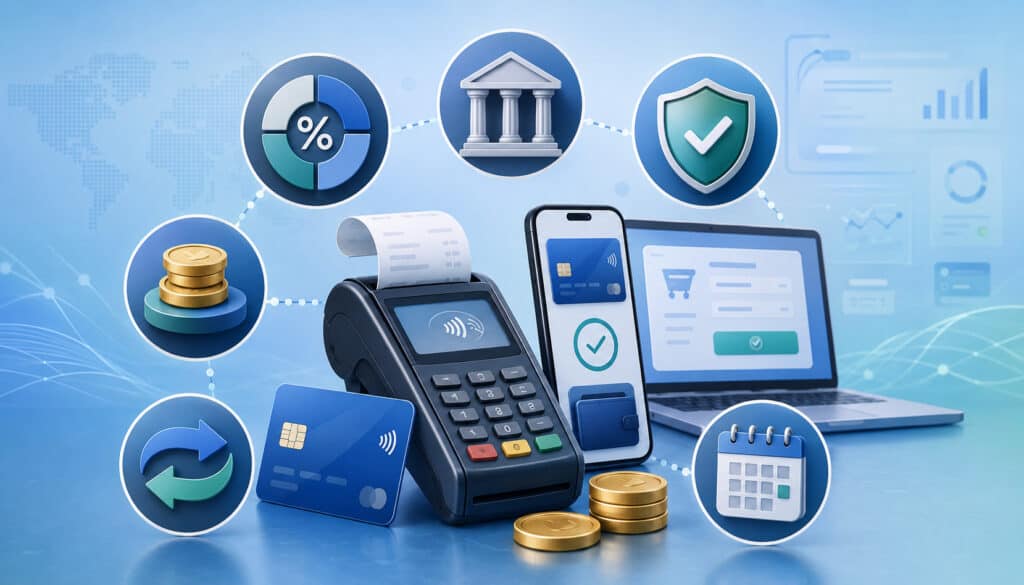
Most Pittsburgh merchant services fees fall into several predictable categories. Understanding them helps business owners spot what is normal, what needs clarification, and what may be negotiable.
Interchange Fees
Interchange fees are usually the largest component of credit card processing costs. These fees are paid to the card-issuing bank and vary based on card brand, card type, transaction method, business category, data quality, and risk level.
For example, a basic debit card transaction accepted in person may cost less than a rewards credit card transaction keyed into a virtual terminal. A card-present transaction usually carries lower risk than a card-not-present transaction, so the cost structure may differ.
Interchange fees are not set by the local payment processor. This is important because some quotes make it sound as if one provider can simply make interchange disappear. A provider may reduce markup, simplify pricing, or improve how transactions qualify, but interchange itself is part of the card network structure.
Businesses should review whether their transactions are downgrading to higher-cost categories because of missing data, late batching, keyed entry, or poor setup. This is especially relevant for service businesses, professional firms, and contractors that accept invoice payments or manually entered card payments.
Assessment Fees
Assessment fees are charged by card networks and are usually smaller than interchange fees. They apply because the transaction uses the network’s infrastructure. Like interchange, assessment fees are generally not negotiable for an individual merchant.
Assessment fees may appear as separate line items on some statements or may be bundled inside a total processing charge. When comparing payment processor fees Pittsburgh merchants receive from different providers, ask whether assessments are passed through separately or bundled into the rate.
A bundled quote may look simple but make it harder to know whether you are paying mostly network costs or processor markup. Interchange-plus statements tend to show these costs more clearly, although they may take more effort to read.
The key point is that assessment fees are part of the baseline cost of card acceptance. A fair comparison should not assume that every fee on a statement is provider profit. Some costs are pass-through costs from the payment ecosystem.
Processor Markup
Processor markup is the part of the cost charged by the payment processor or merchant services provider. This is where quotes can vary widely. Markup may appear as a percentage, a per-transaction fee, a monthly service fee, a gateway fee, or a combination of several charges.
For example, one provider may quote interchange plus a small percentage and transaction fee. Another may quote a flat rate that includes interchange, assessments, and markup. A third may use tiered pricing with qualified, mid-qualified, and non-qualified categories.
Processor markup is often the most important area to review because it may be negotiable and should reflect the level of service, technology, support, risk, and account management provided. A very low quote may not include gateway access, reporting, PCI support, chargeback tools, or responsive service. A high quote may include unnecessary services or inflated fees.
How Credit Card Processing Costs Are Calculated
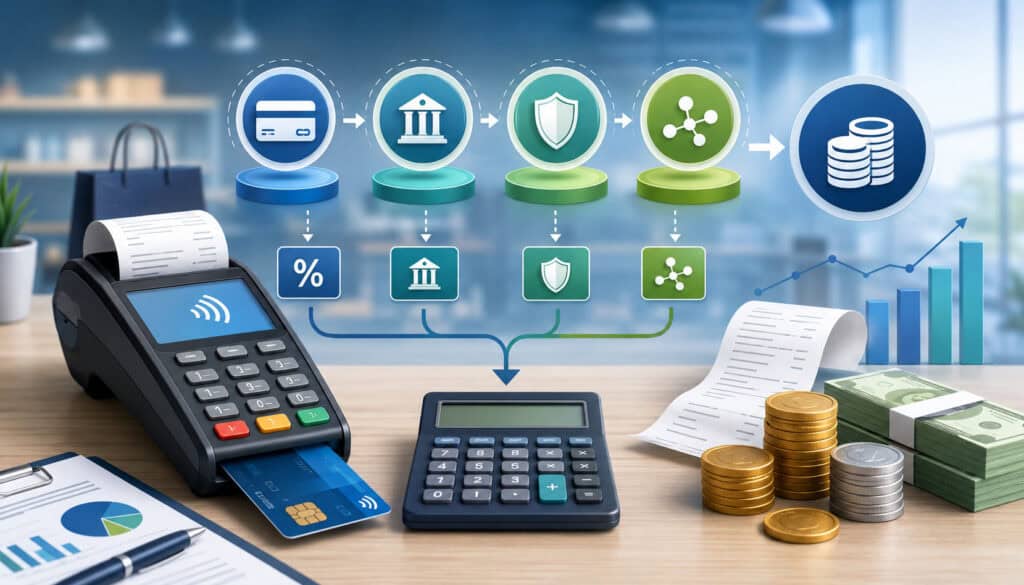
Credit card processing costs are calculated using several variables. A simple percentage does not tell the full story. Businesses need to consider transaction type, card type, sales volume, average ticket size, pricing model, and account fees together.
A basic formula looks like this:
Processing cost = percentage-based fees + per-transaction fees + monthly/account fees + occasional fees
For example, a business processing larger tickets may be more affected by percentage-based fees. A coffee shop, quick-service restaurant, or event vendor with many small tickets may be more affected by per-transaction fees. A professional firm with fewer high-value invoices may have a different cost pattern than a retail shop with hundreds of small daily sales.
Card type matters too. Debit card payments may cost less than premium rewards credit cards. Commercial cards, corporate cards, and manually entered transactions may carry higher costs. Online payments typically have different risk considerations than in-person payments because the card and cardholder are not physically present.
Monthly processing volume also matters. A business processing a few thousand dollars per month may value simplicity and predictable billing. A business processing higher monthly volume may benefit from a more detailed pricing model with lower markup.
Startups should be careful with pricing structures that include high monthly minimums, long contracts, or equipment leases before sales volume is stable.
Risk also affects pricing. Businesses with high chargeback rates, delayed delivery, subscription billing, travel-related services, event deposits, custom orders, or card-not-present activity may face higher costs or stricter underwriting. A clean processing history, clear refund policy, and strong fraud controls can help.
To understand credit card processing costs Pittsburgh businesses actually pay, review the full statement rather than focusing on one rate. The most useful number is often the effective rate, which compares total processing cost to total card sales.
Pricing Models Local Businesses Should Understand

Payment processing rates Pittsburgh businesses see in quotes usually fall into a few pricing models. None is automatically best for every business. The right fit depends on volume, average ticket size, transaction mix, need for simplicity, and how comfortable the business is reviewing statements.
Flat-Rate Pricing
Flat-rate pricing charges one standard percentage, often with a per-transaction fee, for many transaction types. It is popular because it is easy to understand. A small startup, occasional vendor, or low-volume business may appreciate knowing that most card payments are billed at one predictable rate.
The tradeoff is that flat-rate pricing may bundle interchange, assessments, and processor markup together. This can make statements easier to read but harder to audit. Businesses with higher monthly volume or many lower-cost debit transactions may pay more than they would under a more transparent pricing model.
Flat-rate pricing can work well for simplicity, fast setup, seasonal sales, or businesses that do not yet know their processing patterns. However, as volume grows, it is worth comparing the flat-rate total against interchange-plus pricing.
Interchange-Plus Pricing
Interchange-plus pricing separates card network costs from processor markup. A statement may show interchange and assessment fees passed through, plus a clear markup such as a percentage and per-transaction amount.
This model is often considered more transparent because it allows businesses to see what portion of cost comes from card networks and what portion comes from the processor. For many established businesses, interchange-plus pricing can make it easier to compare quotes fairly.
The downside is that statements may look more complex. A Pittsburgh restaurant, retailer, or service business using interchange-plus pricing should be prepared to review multiple line items. Still, the added detail can be valuable, especially for businesses with meaningful monthly volume.
Interchange-plus pricing may be especially useful when comparing merchant services pricing Pittsburgh providers because it reduces confusion around bundled rates. When every provider quotes the same pass-through structure plus a clear markup, comparison becomes more practical.
Tiered Pricing
Tiered pricing groups transactions into categories such as qualified, mid-qualified, and non-qualified. The rate depends on how the transaction is classified. While this model may look simple at first, it can be difficult to predict because many transactions may fall into higher-cost tiers.
A quote may highlight the lowest qualified rate, but that rate may only apply to certain card types and transaction methods. Rewards cards, keyed transactions, commercial cards, or transactions missing required data may be billed at higher tiers.
Tiered pricing is not always unfair, but it requires careful review. Businesses should ask what percentage of their actual transactions typically qualify for each tier and what causes downgrades. Without that information, a low advertised rate may not reflect real costs.
For businesses reviewing Pittsburgh business payment fees, tiered pricing deserves extra attention because it can hide the difference between the quoted rate and the actual effective rate.
| Cost Type | What It Means | When It Applies | What to Watch For |
| Interchange fees | Card-issuing bank cost tied to card type and transaction risk | Most credit and debit card payments | Higher costs for rewards cards, keyed payments, and certain card-not-present transactions |
| Assessment fees | Card network charges | Most card transactions | Whether they are shown separately or bundled |
| Processor markup | Provider charge for processing service | Every pricing model | Percentage markup, per-transaction markup, and unclear bundled margins |
| Monthly account fees | Recurring account or service charges | Usually billed monthly | Multiple overlapping monthly fees |
| Gateway fees | Cost for online payment gateway access | Ecommerce, invoices, recurring billing | Per-transaction gateway fees plus monthly gateway charges |
| PCI compliance fees | Charges tied to payment security support or validation | Businesses accepting cards | Non-compliance penalties or unclear compliance services |
| Batch fees | Fee for closing and submitting daily transactions | In-person and POS environments | Extra costs for frequent batching |
| Equipment costs | POS terminal, reader, or lease cost | Retail, restaurant, mobile, event payments | Long leases, cancellation issues, and outdated hardware |
| Chargeback fees | Fee when a customer disputes a transaction | Any card-accepting business | High dispute rates, weak documentation, and slow responses |
| Refund fees | Fees tied to returning customer funds | Retail, ecommerce, service businesses | Whether original processing fees are returned |
Online, In-Person, Mobile, and Invoice Payment Cost Differences
Payment method affects cost because each channel carries different risk, technology requirements, and data needs. Pittsburgh businesses should evaluate local payment processing costs by how customers actually pay, not by assuming all transactions are equal.
Card-Present Transactions
Card-present transactions happen when the customer physically uses a card, chip, tap, or mobile wallet at a terminal or point-of-sale system. These are common for restaurants, retail shops, salons, medical offices, markets, and event vendors.
Because the card is present and modern terminals can use chip and contactless technology, card-present transactions often have lower fraud risk than keyed or online payments. That can help reduce certain processing costs, depending on the card type and pricing model.
However, in-person payments may involve hardware costs. Businesses may need countertop terminals, handheld restaurant devices, mobile readers, receipt printers, cash drawers, barcode scanners, or integrated POS systems. These tools can improve operations, but they should be evaluated as part of the total cost.
A low transaction rate may not be a good deal if the equipment lease is expensive or difficult to cancel. Businesses should ask whether equipment is purchased, rented, leased, or included with service.
Card-Not-Present Transactions
Card-not-present transactions occur when the card is not physically used at a terminal. This includes ecommerce payments, keyed transactions, invoice payments, phone orders, recurring billing, and some virtual terminal payments.
These transactions usually carry higher risk because it is harder to verify the cardholder. As a result, costs may be higher than card-present payments. Fraud prevention tools, address verification, CVV checks, tokenization, secure payment links, and clear customer communication can help manage risk.
Pittsburgh service providers, contractors, professional firms, consultants, and nonprofits often rely on card-not-present payments because customers may pay remotely. Ecommerce sellers and subscription-based businesses also need this setup.
Higher cost does not mean card-not-present payments should be avoided. They can improve convenience, speed up collections, support remote work, and reduce manual billing. The goal is to price them correctly and reduce unnecessary risk.
ACH Payments, Invoices, and Recurring Billing
ACH payments can be useful for invoices, memberships, subscriptions, donations, tuition-like payments, and larger recurring bills. ACH pricing is often different from card pricing and may be charged as a flat fee, percentage, or capped amount.
For larger invoices, ACH may reduce total payment cost compared with credit cards. However, ACH payments have their own rules, return risks, authorization requirements, and timing considerations. Businesses should understand how returns, insufficient funds, and authorization disputes are handled.
Recurring billing can also affect costs. Tokenized cards, automated retries, account updater tools, and subscription management software may add fees but can reduce failed payments and administrative work.
Industry-Specific Cost Factors for Pittsburgh Businesses
Different industries face different payment patterns. A single pricing model may not work equally well for every business. When reviewing small business payment processing costs, Pittsburgh merchants should compare pricing against their actual industry needs.
Restaurant Payment Costs
Restaurant payments often include many transactions, tips, tabs, split checks, online ordering, delivery integrations, contactless payments, and sometimes handheld devices. A full-service restaurant may need tip adjustment, table management, and after-service batching. A quick-service restaurant may care more about speed, small-ticket transaction fees, and line management.
Restaurants should pay attention to per-transaction fees because high transaction volume can make small fixed fees add up. They should also review online ordering fees, delivery platform integrations, chargeback handling, and whether tips are processed correctly.
Batch timing matters too. If transactions are not batched properly, some payments may downgrade to higher-cost categories. Staff training can reduce errors such as duplicate charges, incorrect tip adjustments, and refund confusion.
Neighborhood restaurants in areas such as the Strip District, South Side, Oakland, Bloomfield, and Squirrel Hill may also have seasonal or event-driven spikes. Processing should be flexible enough to handle volume changes without unnecessary penalties.
Retail Payment Costs
Retail businesses typically process many card-present transactions through a point-of-sale system. Costs may be influenced by debit card usage, rewards credit cards, average ticket size, inventory software, loyalty programs, gift cards, and returns.
A boutique with higher average tickets may be more affected by percentage-based markup, while a convenience-style retailer with smaller tickets may be more affected by transaction fees. Retailers should review both.
Equipment and software are major cost factors. A POS system that tracks inventory, customer profiles, and sales tax reporting may justify a monthly software fee. But businesses should avoid paying for features they do not use.
Retailers should also watch refund practices. If original processing fees are not returned after refunds, frequent returns can increase net processing costs. Clear return policies and accurate receipts help reduce disputes.
Ecommerce Payment Costs
Ecommerce sellers need a payment gateway, fraud controls, secure checkout, shipping communication, refund management, and sometimes subscription or account-based billing. These needs can increase cost compared with a simple in-person setup.
Online transactions are card-not-present, so risk and pricing may be higher. Fraud screening, address verification, CVV checks, 3-D Secure options, tokenization, and order review rules can help reduce chargebacks.
Ecommerce businesses should look beyond the rate and evaluate gateway fees, plugin fees, platform compatibility, chargeback tools, failed payment handling, and reporting. A cheaper processor may cost more if it creates manual work or weak fraud protection.
For more on online and in-person setup considerations, see this local resource on Pittsburgh payment gateway and POS systems.
Service Business Payment Costs
Contractors, consultants, professional firms, repair companies, home service providers, and appointment-based businesses often accept payments through invoices, mobile readers, virtual terminals, or recurring billing.
These businesses may have larger average ticket sizes than restaurants or retail shops. That means percentage-based fees can have a bigger impact. ACH payments may be worth considering for larger invoices, while cards may still be important for convenience and faster collections.
Service businesses should review keyed transaction costs, invoice payment fees, recurring billing fees, mobile reader costs, and chargeback risk. Clear contracts, signed work approvals, detailed invoices, and documented communication can help reduce disputes.
Professional offices should also consider data security, access permissions, and reporting. Staff should only have the payment permissions they need, and sensitive payment data should not be stored insecurely.
Hidden or Overlooked Merchant Processing Costs
Some merchant account fees Pittsburgh businesses pay are easy to miss because they are small, occasional, or buried in monthly statements. These fees are not always improper, but they should be understood.
Common overlooked costs include monthly minimums, annual fees, PCI non-compliance fees, statement fees, batch fees, account maintenance fees, gateway monthly fees, wireless data fees, next-day funding fees, chargeback fees, retrieval fees, address verification fees, voice authorization fees, software integration fees, and equipment replacement costs.
Equipment lease costs deserve special attention. A terminal that could be purchased for a reasonable one-time cost may become expensive if locked into a long lease. Some leases are separate from the processing agreement, which means switching processors may not end the equipment obligation.
PCI compliance fees also vary. Some providers charge for access to compliance tools, while others charge penalties when a business does not complete required validation. The PCI Security Standards Council provides payment security resources for merchants, including guidance for smaller businesses. PCI Security Standards Council
Gateway fees can also surprise businesses. An ecommerce seller may pay a monthly gateway fee, a per-transaction gateway fee, and separate processing fees. An invoice-based business may pay extra for payment links, stored cards, or recurring billing.
Early termination fees and contract auto-renewals should also be reviewed before signing. A business should understand cancellation requirements, notice periods, equipment return rules, and whether pricing can change during the agreement.
How Chargebacks, Refunds, and Fraud Affect Costs
Chargebacks, refunds, and fraud can raise credit card processing fees Pittsburgh businesses experience indirectly. Even when the processing rate stays the same, disputes and fraud create fees, lost merchandise, staff time, delayed funds, and risk flags.
A chargeback occurs when a cardholder disputes a transaction. The business may be charged a fee whether it wins or loses the dispute. If the business loses, it may also lose the transaction amount, product, service time, shipping cost, or administrative effort.
Chargebacks can happen for many reasons: fraud, unclear billing descriptors, duplicate charges, delivery issues, customer dissatisfaction, subscription confusion, refund delays, or weak documentation.
Local businesses can reduce disputes by making receipts clear, using recognizable billing names, documenting service approvals, responding quickly to customer concerns, and keeping proof of delivery or completion.
Refunds also affect cost. Some processors do not return the original processing fees when a refund is issued. For businesses with frequent returns, cancellations, deposits, or event changes, this can increase net cost.
Refund policies should be clear before the sale, especially for custom orders, catering deposits, appointment fees, and nonprofit event registrations.
Fraud prevention is especially important for online payments and keyed transactions. Address verification, CVV checks, secure payment links, device monitoring, velocity controls, and manual review rules can reduce risk.
The Federal Trade Commission offers general business guidance on protecting sensitive information and reducing data-related risk. FTC business guidance
How to Read a Merchant Statement and Calculate Effective Rate
A merchant statement shows how much your business processed and what you paid to accept payments. It may be simple or detailed depending on the provider and pricing model. To compare Pittsburgh merchant processing costs, the most useful starting point is the effective rate.
Effective Rate Calculation
Effective rate shows your total processing cost as a percentage of total card sales. It gives a more complete picture than a quoted rate because it includes transaction fees, monthly fees, gateway fees, and other processing-related charges.
Use this formula:
Effective rate = total processing fees ÷ total card sales × 100
For example, if a business processed $40,000 in card payments and paid $1,200 in total processing-related fees, the effective rate is 3%. If another quote advertises a lower rate but adds monthly fees, gateway fees, and equipment charges, the actual effective rate may not be lower.
When calculating effective rate, include all processing-related costs for the month. This may include discount fees, transaction fees, monthly fees, PCI fees, gateway fees, batch fees, chargeback fees, and equipment charges. Exclude unrelated business expenses.
Compare effective rate across several months. A restaurant may have different results during a busy event season. A retailer may see changes during holiday shopping periods. A contractor may have months with fewer but larger invoices.
What to Look for on the Statement
Start with total processing volume, number of transactions, average ticket size, total fees, and pricing model. Then look for line items that repeat monthly or appear without clear explanation.
Check whether transactions are separated by card type and transaction method. Review how many were swiped, dipped, tapped, keyed, online, or invoice-based. If too many transactions are keyed when they could be sent through secure payment links or card-present methods, costs may be higher than necessary.
Look for downgrades or non-qualified transaction categories if your statement uses tiered pricing. These may indicate missing data, settlement delays, card type issues, or transaction method problems.
Review chargebacks, refunds, authorization fees, gateway fees, and PCI-related charges. If the statement includes unfamiliar abbreviations, ask for a written explanation.
Practical Ways to Lower Payment Processing Costs
Lowering payment processing rates Pittsburgh businesses pay does not always mean chasing the lowest advertised rate. It means improving the full cost structure while keeping payment acceptance reliable, secure, and convenient for customers.
Start by understanding your current effective rate. Then identify which costs are pass-through, which are markup, and which are monthly or avoidable fees. This prevents wasted effort negotiating costs that cannot realistically be changed while overlooking costs that can.
Businesses can often reduce costs by:
- Choosing a pricing model that fits actual volume and transaction mix
- Reducing keyed transactions when secure alternatives are available
- Using chip, tap, and contactless payments for in-person sales
- Batching transactions on time
- Completing PCI compliance requirements promptly
- Reviewing monthly and annual account fees
- Avoiding long equipment leases when purchase options are better
- Using ACH payments for suitable large invoices or recurring bills
- Improving refund policies and customer communication
- Reducing chargebacks with documentation and fraud controls
- Comparing quotes using the same sales assumptions
- Reviewing contract terms before signing
For local setup planning, this Pittsburgh merchant services setup checklist offers additional context on merchant accounts, hardware, software, and payment workflows.
Businesses should also train staff. Many avoidable costs come from operational mistakes: duplicate charges, late batches, manual entry when a card reader is available, unclear receipts, or poor refund handling. Staff who understand the basics can help reduce processing friction.
Security also plays a role. Following PCI standards, using secure equipment, limiting access to payment data, and avoiding unsafe storage of card information can reduce risk. The PCI council’s small merchant resources are useful for understanding practical payment security expectations. PCI small merchant guide
Questions to Ask Before Choosing a Payment Processor
Before choosing or switching a payment processor, Pittsburgh businesses should ask questions that reveal the full cost, not just the headline rate. A good evaluation should cover pricing, service, funding, security, equipment, software, contract terms, and dispute handling.
Start with pricing transparency. Ask which pricing model is being offered: flat-rate, interchange-plus, tiered, subscription-style, or another structure. Ask what the processor markup is and whether interchange and assessment fees are passed through separately or bundled.
Then ask about monthly and occasional fees. This includes statement fees, PCI fees, gateway fees, batch fees, chargeback fees, refund fees, account maintenance fees, next-day funding fees, and monthly minimums. Ask for a sample statement if possible.
Equipment and software questions are also important. Is the terminal purchased, rented, leased, or included? Who owns the equipment? Is it compatible with the POS system, ecommerce platform, accounting software, or invoicing tool? What happens if the business switches providers?
Contract review matters. Ask whether there is a long-term agreement, early termination fee, auto-renewal clause, price change clause, or separate equipment contract. Also ask how cancellation works and what notice is required.
Businesses should also ask about support. What happens if payments fail during a busy dinner shift, retail rush, market day, or online promotion? Is support available when the business actually operates?
Useful questions include:
- What is the estimated total monthly cost at my current processing volume?
- Which fees are pass-through costs and which are processor markup?
- How are card-present and card-not-present transactions priced?
- Are debit card payments priced differently from credit card payments?
- What gateway, virtual terminal, and invoicing fees apply?
- Are PCI compliance tools included?
- What are the chargeback fees and dispute response procedures?
- Is next-day funding available, and does it cost extra?
- Are there monthly minimums or annual fees?
- What contract terms apply if I cancel or change equipment?
For a broader local overview, this guide to secure Pittsburgh merchant services and POS systems may help businesses think through payment acceptance options.
What are typical payment processing costs for Pittsburgh businesses?
Typical costs vary by business type, transaction method, average ticket size, monthly processing volume, card mix, risk profile, pricing model, and provider terms. In-person debit transactions may cost less than keyed credit card transactions or ecommerce payments.
A restaurant with many small tickets may have a different cost structure than a contractor processing larger invoices. The best way to understand your cost is to calculate your effective rate using total monthly fees divided by total card sales.
What fees are included in payment processing costs?
Payment processing costs may include interchange fees, assessment fees, processor markup, per-transaction fees, monthly account fees, statement fees, PCI compliance fees, gateway fees, batch fees, virtual terminal fees, equipment costs, chargeback fees, refund fees, and funding fees.
Not every business pays every fee. The exact cost depends on the payment setup, provider agreement, and transaction mix.
Why do credit card processing fees vary by business?
Fees vary because businesses do not process payments in the same way. Card-present transactions, ecommerce payments, keyed invoices, mobile payments, recurring billing, and ACH payments all have different cost and risk factors.
Card type also matters. Rewards cards, commercial cards, debit cards, and manually entered cards may price differently. Chargeback history, industry risk, average ticket size, and monthly volume can also affect pricing.
What is the difference between interchange fees and processor markup?
Interchange fees are set by card networks and paid to the bank that issued the customer’s card. They are a major part of the cost of accepting card payments.
Processor markup is the amount charged by the payment processor or merchant services provider for account service, technology, processing access, risk management, and support. Interchange is generally not negotiable for an individual business, while processor markup may be.
How can local businesses calculate their effective processing rate?
Add up all processing-related fees for the month, then divide that number by total card sales for the same period. Multiply by 100 to get a percentage.
For example, if total processing fees are $900 and card sales are $30,000, the effective rate is 3%. Include transaction fees, monthly fees, gateway fees, PCI fees, batch fees, and other processing-related charges for the most accurate result.
Are online payments more expensive than in-person payments?
Online payments are often more expensive than in-person card-present payments because they are card-not-present transactions. That means the card is not physically tapped, dipped, or swiped at a terminal, which can increase fraud risk.
Ecommerce payments may also require a payment gateway, fraud tools, secure checkout, and software integrations. However, online payments can still be valuable because they improve convenience, support remote sales, and help businesses get paid faster.
How can businesses lower payment processing costs?
Businesses can lower costs by reviewing statements, calculating effective rate, reducing keyed transactions, using secure card-present methods when possible, batching on time, completing PCI compliance requirements, avoiding unnecessary equipment leases, improving fraud prevention, reducing chargebacks, and comparing pricing models fairly. For larger invoices or recurring payments, ACH may also be worth evaluating.
What questions should businesses ask before choosing a processor?
Ask about the pricing model, processor markup, monthly fees, gateway fees, PCI fees, chargeback fees, equipment costs, funding timelines, contract length, cancellation terms, software compatibility, and support availability.
Also ask for a full cost estimate based on your actual monthly volume, average ticket size, and payment methods. The clearest quotes explain both the rate and the total expected monthly cost.
Conclusion
Understanding Pittsburgh payment processing costs gives local businesses more control over margins, cash flow, customer experience, and vendor decisions. Payment processing is not just a percentage on a quote.
It is a combination of interchange fees, assessment fees, processor markup, monthly account costs, gateway fees, equipment expenses, compliance-related charges, chargeback costs, refund policies, and contract terms.
The right setup depends on how your business accepts payments. A restaurant may prioritize POS speed, tips, and per-transaction costs. A retailer may focus on in-person payments, inventory integration, and return handling.
An ecommerce seller may need gateway reliability and fraud tools. A contractor or professional office may care most about invoice payments, ACH options, virtual terminal access, and larger-ticket costs. A nonprofit may need donation forms, recurring billing, and clear reporting.
The most practical step is to calculate your effective rate, review several months of statements, and separate unavoidable network costs from provider markup and avoidable fees. Then compare quotes using the same assumptions: processing volume, average ticket size, transaction type, card mix, software needs, equipment requirements, and funding expectations.
Pittsburgh businesses do not need to become payment network experts to make better decisions. They need a clear understanding of what they are paying, why they are paying it, and which costs can be improved.
With careful statement review, good payment security practices, clear customer policies, and transparent contract terms, businesses can manage payment processing costs more confidently while still offering customers the convenient payment options they expect.