By pittsburgh-merchantservices October 17, 2025
Accepting eChecks and ACH payments online is one of the most cost-effective ways to move money in the U.S. For many businesses, ACH lowers fees, speeds up cash flow, and reduces card dependence.
In this guide, you’ll learn exactly how eChecks flow through the ACH Network, what you need to stay compliant, and the practical steps to start accepting eChecks and ACH payments online with confidence.
You’ll also see proven UX tips, fraud controls, pricing benchmarks, and the operational playbook for handling returns and disputes. Whether you run an ecommerce storefront, invoice clients, or collect recurring subscriptions, this updated U.S.-focused handbook gives you everything you need to set up, launch, and optimize eChecks and ACH payments online.
What Are eChecks and ACH Payments?
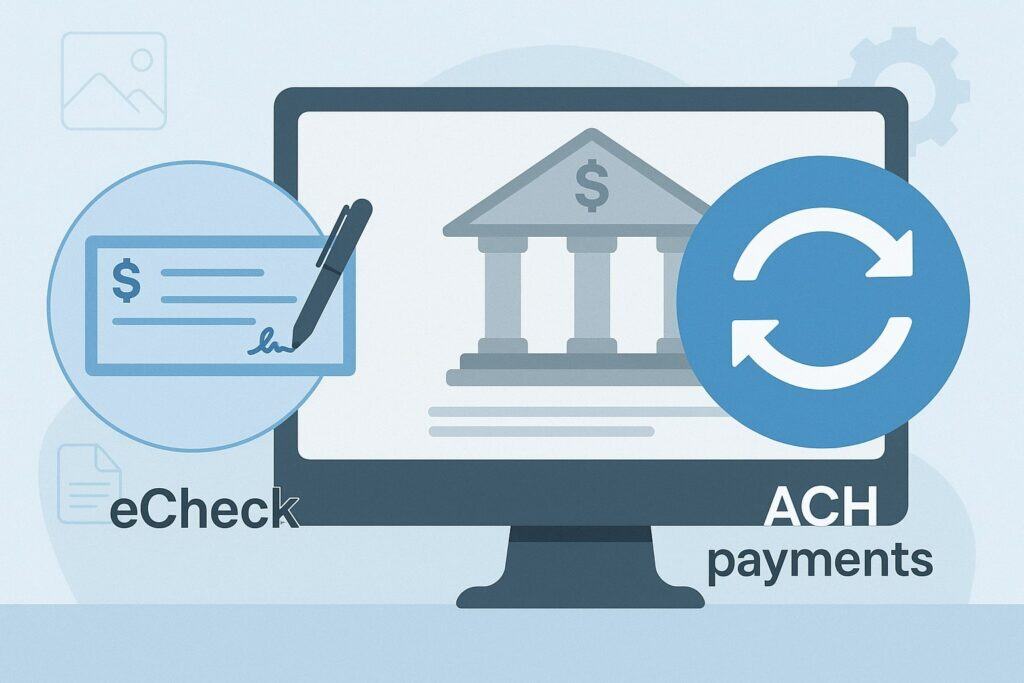
At a high level, ACH (Automated Clearing House) is the U.S. bank-to-bank rails used for electronic credits and debits.
An eCheck is simply an electronic debit that mirrors the data elements of a paper check—routing number, account number, account type, and authorization—processed through the ACH Network instead of the physical clearing process.
When you accept eChecks and ACH payments online, your customer gives permission (authorization) for you to debit their bank account for a specific amount or on a recurring schedule.
Your ACH Originator (often your payment processor or gateway) packages that debit and sends it through an ODFI (Originating Depository Financial Institution) into the ACH Network, which settles with the customer’s bank (the RDFI).
The ACH rails support two primary flows you’ll see online: ACH credit (payer pushes funds to you, e.g., “Pay by bank”) and ACH debit (you pull funds from the payer after they authorize it). eChecks are ACH debits.
Credits are popular for bill-pay experiences where customers log into their bank to “push” money; debits are popular for ecommerce, invoicing, and subscriptions where you collect authorization and initiate the pull.
For U.S. businesses, the appeal of eChecks and ACH payments online is strong: fees are typically a fraction of card interchange, you can support high-ticket items without card limits, and recurring billing becomes simpler and stickier because bank accounts don’t expire like cards.
From a records perspective, you’ll work with NACHA (the ACH rulemaking body) definitions such as WEB (consumer-initiated online debit), PPD (prearranged consumer debits, often recurring), CCD (corporate debits/credits), and CTX (corporate payments with addenda).
For most online checkout or invoice payment flows with consumers, WEB debits are standard; for B2B pulls, CCD is common. Understanding these codes matters because they drive authorization requirements, security controls, and return timeframes.
Getting these basics right ensures you accept eChecks and ACH payments online in a way that’s reliable, compliant, and optimized for fewer returns.
How eChecks Move Through the ACH Network (Step-By-Step)
When you accept eChecks and ACH payments online, the technical flow follows a predictable path. First, your site or invoice captures bank details.
This can be done via traditional routing/account entry, via micro-deposits verification, or increasingly via instant account verification (IAV) using secure bank login or tokenized account linking. Next, your gateway creates an ACH entry (e.g., a WEB debit) and batches it for submission to the ODFI.
Unlike card rails that authorize in real time, ACH is a batch network. Files are sent in windows throughout the business day, including Same Day ACH windows that support faster crediting and debiting for eligible entries and dollar limits.
After the ODFI submits the file, the ACH Operator (FedACH or The Clearing House) routes entries to each RDFI.
The RDFI posts the debit to the customer’s account and, if necessary, issues a return with a reason code (e.g., R01 Insufficient Funds, R03 No Account, R29 Corporate customer advises not authorized).
Funds typically settle to the Originator T+1 or T+2 business days for standard ACH, and same-day or next-day for Same Day ACH, depending on cut-offs. In parallel, your processor updates the transaction state in your dashboard or API so your order management system can ship goods or release services when risk rules pass.
The authorization record is a crucial part of accepting eChecks and ACH payments online. For consumer WEB debits, NACHA requires you to present and store a clear authorization (screen text or checkbox agreement), capture the amount (or variable billing terms), the date/schedule, and provide a way to revoke authorization.
For phone orders, TEL entries apply; for mail or written orders, PPD with written authorization is used. Maintaining these records helps you defend against unauthorized claims and respond to RDFI inquiries.
Finally, reconciliation lands in your bank via a consolidated ACH settlement, and your gateway provides transaction-level reporting so you can allocate funds to orders, subscriptions, or invoices.
Why Accept eChecks and ACH Payments Online (Benefits & Use Cases)
Businesses adopt eChecks and ACH payments online to reduce costs, improve acceptance, and power recurring revenue. Lower cost is the headline: ACH pricing is often a flat fee per transaction (e.g., $0.20–$1.50) or a very small percentage compared to card fees.
On a $1,500 invoice, cards might cost $45+ in interchange and assessments; ACH could be under $2, making ACH ideal for high-ticket items, B2B invoices, tuition, healthcare, professional services, and construction draws.
Higher acceptance is another win: customers who avoid entering card numbers or who don’t have significant card limits can still pay from their bank accounts. And because bank accounts don’t expire, recurring billing via ACH sees fewer payment method churn issues than cards.
Operational benefits compound as you scale. ACH is reversible when necessary, so you can process refunds cleanly without card network constraints. You can tokenize bank accounts to support one-click checkouts and subscription renewals that keep lifetime value strong.
With IAV and Same Day ACH, the experience is now fast enough for many ecommerce scenarios where you used to rely on cards. You can also layer surcharging or discounting strategies (e.g., “Pay by bank and save 2%”) to steer customers toward a lower-cost rail and pass savings along.
Common use cases include ecommerce checkout with “Pay by bank,” invoice payment links inside emails or customer portals, recurring subscriptions for SaaS and memberships, rent collection, B2B billings with CCD/CTX, and non-profit donations.
If you sell regulated or high-ticket goods where card acquirers are conservative, accepting eChecks and ACH payments online can unlock approvals with strong verification. Overall, ACH offers a powerful mix of cost control, reliability, and flexibility that makes it a strategic payment method alongside cards and wallets.
eChecks vs. Cards, Wires, and Real-Time Payments
When you compare eChecks and ACH payments online to other rails, think in terms of cost, speed, risk, UX, and fit. Against credit cards, ACH has far lower variable costs and better longevity (no expirations), but cards provide immediate authorization and strong consumer protections that can boost conversion in impulse-buy retail.
For wires, ACH is cheaper by orders of magnitude and works well for recurring schedules, but wires post faster, are final, and are favored for very large or time-critical corporate transfers.
With Real-Time Payments (RTP) and emerging “pay-by-bank” push flows, you’ll see instant or near-instant crediting and finality. However, RTP isn’t universal for all banks yet, and most online merchants still prefer ACH debits for seamless checkout and subscription pulls.
From a risk perspective, cards have chargebacks managed by card networks, while ACH has returns governed by NACHA with specific reason codes and windows.
Unauthorized consumer ACH debits can be returned within 60 days; most administrative or NSF returns occur quickly (often within 2–5 business days). With proper authorization and verification (IAV, micro-deposits, or account-owner checks), ACH return rates can be kept very low.
In terms of speed, Same Day ACH narrows the gap significantly, and many processors now offer funding T+0 to T+1 for eligible entries, making ACH viable even for faster-moving businesses.
For user experience, cards benefit from consumer familiarity and autofill, while eChecks and ACH payments online get a UX boost from modern bank-linking SDKs that remove manual routing/account entry.
The best strategy is choice architecture: present Pay by Bank (ACH) prominently next to cards, explain the savings or benefits, and allow customers to select the method that best fits each purchase. Over time, many businesses see a growing share of sales move to ACH once it’s offered and explained clearly.
Compliance, Authorization, and NACHA Essentials
NACHA rules govern how you accept eChecks and ACH payments online in the U.S. The most important operational concept is authorization. For WEB entries (consumer online), your checkout must display consent language that covers debit amount or range, timing (one-time or recurring), revocation instructions, and contact details.
The customer must take an affirmative action (e.g., checking a box and clicking Pay). For recurring debits, you must provide a copy of the authorization and a way to cancel.
If you accept payments over the phone, TEL entries require recorded or written authorization; for mail or paper forms, PPD applies. For B2B, CCD/CTX entries rely on written agreements between businesses.
NACHA also sets data security expectations. You must protect bank account numbers in transit and at rest using encryption and secure storage or rely on your gateway’s tokenization so your systems never touch raw account numbers.
WEB debits carry additional fraud-prevention obligations: you need to employ “commercially reasonable” identity/authentication methods such as device fingerprinting, negative file checks, velocity limits, IP geolocation, and account verification.
Many processors meet these with built-in tools, but you remain accountable as the Originator for maintaining a fraud program and monitoring return rates.
Finally, be mindful of return thresholds. Excessive rates for R10/R11 (unauthorized) or R01/R09 (NSF/Uncollected) can trigger monitoring and corrective action. Set policies for notice of changes (NOCs) when banks advise updated account data, and implement annual reviews of your ACH authorization language and flows.
Keep your customer service easy to reach—clear visibility and fast responses reduce disputes and unauthorized claims. Compliance isn’t red tape; it’s the backbone of long-term success with eChecks and ACH payments online.
Fraud Prevention and Handling ACH Returns
Unlike card chargebacks, ACH returns are code-driven and, with the right controls, highly manageable. Start by verifying accounts before you pull funds. Instant Account Verification (IAV) via secure bank login confirms account ownership and status in seconds and can dramatically lower R03 (No Account) and R02 (Closed Account) returns.
If IAV isn’t available, micro-deposits—two small credits the customer confirms—create a low-friction, compliant path to validate routing/account numbers. Add risk scoring for first-time payers, velocity limits for amount/frequency, and positive/negative files to block suspicious accounts.
Operationally, expect most administrative returns (e.g., R03, R04 Invalid Account) within 2–3 business days and NSF returns (R01) shortly after presentment.
Use representation policies for NSF where permitted—some processors allow a second debit automatically or on a schedule when balances recover. For unauthorized claims (R10/R11), pull the authorization record quickly and determine whether to refund or contest based on evidence.
Build a simple playbook: (1) identify the return code, (2) automate the customer notification, (3) decide on re-attempt or alternate method (card, RTP push), and (4) update fulfillment rules to avoid shipping goods until risk clears.
Finally, keep dashboards and alerts tuned. Set thresholds for same-day shipping holds on first-time bank payments over a set amount, and review daily return reports to catch patterns. With these controls, you’ll keep ACH returns within acceptable ranges and preserve the cost advantage of accepting eChecks and ACH payments online.
Step-By-Step: Setting Up to Accept eChecks and ACH Online
Getting live is straightforward when you follow a clean checklist. First, choose a payment processor/gateway that supports ACH debits (WEB, PPD, CCD/CTX), Same Day ACH, and modern verification (IAV and/or micro-deposits).
Confirm features for recurring billing, invoice links/hosted checkout, and developer APIs if you plan to integrate. Ask about funding timelines (e.g., T+1 for low-risk WEB/PPD), risk programs, and reporting exports.
Second, complete underwriting. You’ll provide business formation docs, ownership (KYC), banking info, website URL, refund policy, and product descriptions. For certain verticals, expect extra due diligence or reserves.
Third, configure your authorization language and payment pages. Make the Pay by Bank option visible, explain the benefit (“lower fees,” “instant confirmation,” or “save on convenience fee”), and ensure your terms meet NACHA requirements.
Fourth, set up account verification. If you use IAV, embed the provider’s SDK for a familiar bank-login UX. If you use micro-deposits, enable automated verification within your portal so customers can confirm in one step when the small credits land.
Fifth, define risk rules: shipping holds for first-time bank payers over $X, velocity caps, and soft-decline flows that fall back to a different method.
Finally, test end-to-end. Run a $1.00 live transaction to confirm settlement, test your webhooks or processor callbacks, and validate that invoices and subscriptions trigger the correct ACH entries.
Train your team on returns handling, refunds, and customer questions (“How long until the debit posts?” “What if I typed the wrong account number?”). Once you’ve validated the flow, you’re ready to accept eChecks and ACH payments online at scale with a launch plan that emphasizes the benefits and supports quick adoption.
Integration Options: API, Hosted Checkout, and Invoicing
You can accept eChecks and ACH payments online with three common integration patterns. Hosted checkout is the fastest: your provider hosts the payment page, handles PCI-scope reduction, renders bank-link widgets, and stores authorizations.
You customize branding and embed a “Pay Invoice” or “Pay Now” link in your site or emails. This is ideal for non-technical teams and quick launches. Invoicing/Payment links extend hosted checkout into your AR workflow, letting you send one-time or recurring invoice links that settle via ACH and reconcile automatically.
For deeper control, use a server-side API. You’ll create customers, attach bank accounts (via IAV or micro-deposits), and initiate WEB debits programmatically. APIs support complex pricing, addenda records for CCD/CTX, and ERP integrations that sync settlements to your GL.
Add webhooks to receive event notifications on verification status, submission, returns, and refunds. Many teams combine options: API for subscriptions and portals, hosted checkout for quick pay flows, and invoices for AR.
Whatever you choose, prioritize tokenization, clear error messages (e.g., “Account not found—please re-link”), and robust retries that keep eChecks and ACH payments online running smoothly.
User Experience Best Practices for Higher Conversion
Strong UX is the difference between a checkbox payment method and a high-adoption channel. Start with prominence: place “Pay by Bank (ACH/eCheck)” next to cards, not in a hidden menu. Add a brief value prop like “No card fees” or “Secure bank transfer.”
If you use IAV, present a bank search box and common logos to speed selection. Keep the form minimal: only ask for what you truly need. For manual entry, validate the routing number in real time and format account numbers clearly with masked input. Display concise authorization language above the pay button with a checkbox and link to full terms.
Set customer expectations about timing. Even with Same Day ACH, customers may not see the debit immediately in online banking. Provide a confirmation page that states, “We received your authorization. Funds will be withdrawn within 1–2 business days.”
For subscriptions, show the next debit date and include an easy cancel/update link in the customer portal. For high-value orders, disclose that bank payments may require verification or a brief review hold. Transparency reduces support tickets and unauthorized claims.
Finally, design for recovery. If bank linking fails, offer a clean fallback to manual entry or card. If micro-deposits are required, send automated reminders with a secure verification link the moment the credits post.
Save progress and allow customers to resume without re-entering data. These small details significantly increase completion rates and make accepting eChecks and ACH payments online feel modern and trustworthy.
Pricing, Fees, and Settlement Expectations
One of the strongest reasons to accept eChecks and ACH payments online is the predictable cost structure. Many U.S. providers price ACH as a flat per-transaction fee (e.g., $0.25–$1.50) or a low percentage (e.g., 0.5% capped at a few dollars).
There may be small monthly fees for ACH enablement, Same Day ACH surcharges, or fees for IAV/micro-deposits. Compare funding timelines carefully: standard ACH often funds T+2, while many providers offer T+1 or same-day funding for low-risk categories and amounts.
Same Day ACH can add a modest premium, but the faster settlement can be well worth it for inventory or service release.
Model your unit economics by order size. At $100, a $1 ACH fee equals 1%; at $1,500, a $1 ACH fee equals 0.07%, which is a major savings versus card acceptance. Consider offering a small cash discount or “Pay by bank & save” incentive to steer adoption—check state rules and card network guidelines if you also surcharge cards.
Ask about NSF/return fees, refund fees, and whether your provider supports automatic re-presentments for NSF returns. For B2B, confirm CTX/CCD addenda support and any fees for larger files or remittance data.
For accounting, ensure you get daily settlement reports, a clear ACH descriptor, and summary files that map deposits to transaction IDs. Reconcile settlement net of fees or gross with monthly billing—whichever makes your GL cleaner.
With the right provider, the combination of low ACH fees and streamlined reporting delivers a reliable foundation to scale eChecks and ACH payments online without margin surprises.
Troubleshooting and Day-to-Day Operations
Even with a great setup, day-to-day management determines how smooth your eChecks and ACH payments online will run. Start with returns monitoring. Review daily return files and categorize by code: R01 (NSF), R02 (Closed Account), R03 (No Account), R29 (Corporate not authorized), R10/R11 (Unauthorized).
Build automated responses: notify the customer, provide a secure link to re-verify or choose another method, and schedule a re-attempt for NSF where permitted. Keep a negative file of accounts with repeated issues and block them.
Next, streamline customer support. Publish a short FAQ: how long ACH takes, how to update a bank account, and how refunds work. Train agents to recognize return codes and to request the authorization timestamp and IP/device data when investigating claims.
For subscriptions, keep dunning sequences that escalate from friendly reminders to payment-method updates. For B2B, coordinate remittance details so your AR team can match incoming credits quickly.
Finally, invest in observability. Use dashboards and webhooks to track submission cut-offs, Same Day eligibility, success rates by verification method, and time-to-funding.
These metrics help you tune UX (e.g., promoting IAV more aggressively) and tighten risk rules without hurting conversion. With a lightweight but disciplined operational cadence, accepting eChecks and ACH payments online becomes a low-effort, high-impact revenue channel.
FAQs
Q.1: How fast do ACH payments settle?
Answer: Standard ACH typically settles in one to two business days after submission. Same Day ACH can move money the same business day if you meet file cut-offs and entry eligibility. Your processor’s funding policy (e.g., T+1) ultimately controls when funds land in your bank.
Q.2: Are eChecks safe?
Answer: Yes—when implemented properly. Use TLS encryption, tokenization, and account verification (IAV or micro-deposits). Follow NACHA’s WEB security guidelines and maintain authorization records. Add fraud controls like velocity limits, device checks, and negative files.
Q.3: What’s the difference between ACH debit and credit?
Answer: An ACH debit (eCheck) pulls funds from the customer’s account after authorization. An ACH credit pushes funds from the customer’s bank to you (common in bill-pay). Many merchants offer both: debit at checkout and credit via B2B portals or bank bill-pay.
Q.4: Can I refund an ACH payment?
Answer: Yes. You can issue an ACH credit (refund) back to the original account. Refund timing depends on your processor’s batch windows. Communicate clearly to customers that the credit may post 1–3 business days later.
Q.5: What if a customer says a debit is unauthorized?
Answer: Retrieve your authorization (screen, checkbox, timestamp, and terms). For consumer accounts, banks allow returns for 60 days on unauthorized entries. Investigate quickly, refund when appropriate, and tighten verification for similar orders.
Q.6: Do ACH payments work for subscriptions?
Answer: Absolutely. ACH is excellent for recurring billing because bank accounts don’t expire. Combine ACH with dunning flows and a self-service portal so customers can update bank details, view upcoming debits, and manage cancellations.
Q.7: What information do I need from the customer?
Answer: At minimum: routing number, account number, account type (checking/savings), name, authorization, and contact details. If you use IAV, the bank-link flow supplies a token instead of raw numbers.
Q.8: Can businesses pay me via ACH?
Answer: Yes—use CCD/CTX for B2B debits/credits, which support remittance addenda. Provide payment instructions or a portal. Many AR teams prefer ACH for invoices because it’s cheaper and integrates well with ERP systems.
Conclusion
eChecks and ACH payments online are no longer a niche add-on—they’re a strategic channel that cuts costs, improves acceptance, and powers reliable recurring revenue.
By understanding how eChecks move across the ACH Network, aligning with NACHA rules, and deploying modern verification, you can deliver a fast, trustworthy bank-payment experience. Focus on clear authorization, streamlined UX, and a simple operations playbook for returns.
Price ACH competitively, explain the benefits at checkout and in invoices, and watch adoption grow as customers embrace Pay by Bank.
If you’re ready to move beyond card-only checkouts, start with a provider that offers Same Day ACH, IAV, hosted checkout, and strong reporting. Test your flows end-to-end, publish a concise ACH FAQ, and train your team on return codes and risk thresholds.
With these pieces in place, accepting eChecks and ACH payments online will become one of the highest-leverage decisions you make for margins, cash flow, and customer satisfaction in the U.S. market.