By Willis Jarvis February 7, 2026
Surcharging in Pittsburgh can be a smart way to recover card acceptance costs—if you do it the right way. The catch is that “right” is a layered concept.
You’re balancing Pennsylvania requirements, federal consumer-protection expectations, and card-network rules that act like a private regulatory system (and can be enforced through your processor/acquirer).
This guide walks you through surcharging in Pittsburgh in a practical, compliance-first way: what’s allowed, what’s risky, how to implement it in-store and online, how to avoid common mistakes, and how to future-proof your program.
Throughout, you’ll see the core theme: surcharging in Pittsburgh is less about a single law and more about doing transparent pricing with correct disclosures, correct caps, and correct transaction setup.
Understanding the Legal Landscape for Surcharging in Pittsburgh
Surcharging in Pittsburgh is generally permitted, but it’s not a “do whatever you want” situation. Think of the compliance stack as three layers. First, you have Pennsylvania rules and any state-level developments that may tighten disclosure and limits.
Second, you have general consumer-protection principles—mainly that pricing can’t be deceptive or misleading. Third, you have card network rules (Visa, Mastercard, etc.) that you must follow because your ability to accept cards depends on them.
From the network side, Visa’s merchant guidance makes several core points that drive how surcharging in Pittsburgh should work in practice: surcharges can apply to credit cards (not debit/prepaid), you must provide disclosures at key points in the customer journey, and you must keep your surcharge within Visa’s cap.
Mastercard’s rules similarly allow surcharging on Mastercard credit, not debit/prepaid, and require advance notice and clear disclosure; Mastercard also describes a maximum surcharge cap (noting a 4% maximum cap in its summary, though your effective cap often becomes lower because “actual cost” and other network limits still apply).
Where Pennsylvania comes in: even when a state doesn’t outright ban surcharges, state lawmakers can impose specific disclosure timing and “no more than actual processing cost” limitations.
Proposed legislation in Pennsylvania has focused on exactly those themes—disclosure before completion and limit to actual cost—so surcharging in Pittsburgh should be designed as if an auditor will ask, “Where did you disclose it, when, and how did you calculate the rate?”
Key Definitions: Surcharge vs Cash Discount vs Convenience Fee
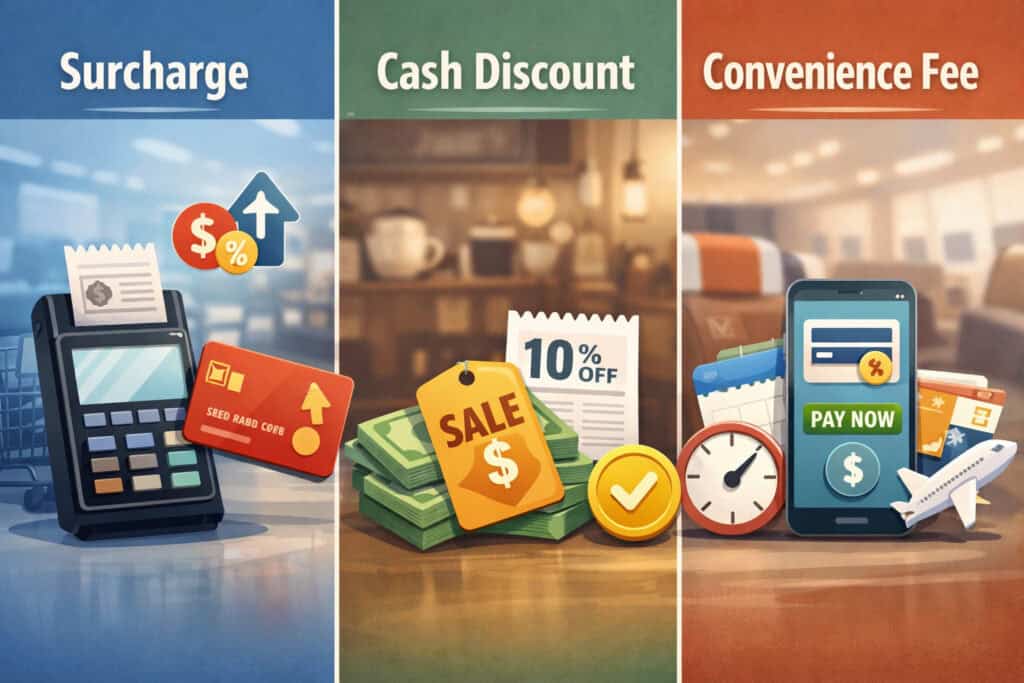
One reason surcharging in Pittsburgh gets messy is that people use the wrong label for the wrong fee. Labels matter because network rules and consumer expectations differ depending on what you’re doing.
A credit card surcharge is an added amount charged because the customer used a credit card. Visa describes a surcharge as an additional fee added for using a particular form of payment and then sets rules on how and when it can be applied.
Mastercard similarly treats it as an “extra checkout fee” applied when paying with Mastercard-branded credit cards (not debit/prepaid).
When you surcharge, you must ensure your point-of-sale system can identify credit vs debit and apply the fee only to eligible credit transactions. That operational detail is a major compliance failure point in surcharging in Pittsburgh.
A cash discount program is different. With a true cash discount, your posted price is effectively the card price (or you post both prices), and customers paying with cash receive a discount.
Visa explicitly draws the line: if you “achieve” the difference by adding an extra fee at checkout, that may be treated as a surcharge and becomes subject to surcharge rules. In other words, if your “cash discount” is implemented like “add 3% when a card is used,” you’re back to surcharging in Pittsburgh.
A convenience fee is another separate concept and is often restricted to particular channels or scenarios (for example, certain types of payments or payment environments). The compliance posture is different, and misclassifying a convenience fee is a classic way merchants stumble.
If your goal is to recover processing costs in a normal retail checkout flow, surcharging in Pittsburgh is typically the relevant category—but only if you follow the credit-only and disclosure rules.
Bottom line: choose one model, name it accurately, implement it technically correctly, and disclose it consistently. The fastest path to problems is mixing models (calling it a “cash discount” while charging it like a surcharge).
Card Network Rules You Must Follow for Surcharging in Pittsburgh

Even if Pennsylvania law is permissive, surcharging in Pittsburgh still lives and dies by card network requirements because your processor and acquiring bank must follow those rules too. The networks can enforce compliance through audits, mystery shopping, consumer complaints, and acquirer penalties.
Visa requirements (high impact)
Visa’s published Q&A for merchants lays out several requirements that directly shape how you implement surcharging in Pittsburgh:
- Notify your acquirer at least 30 days before you start.
- Only surcharge credit (no debit or prepaid), even if a debit cardholder selects “credit” on the terminal.
- Cap the surcharge at the lower of your merchant discount rate (MDR) for the applicable credit card or 3%, whichever is lower.
- Disclose clearly at the point of entry, point of sale/transaction, and on receipts.
- Ensure your transaction messaging supports the surcharge data field (Visa references a dedicated field for surcharge data).
Mastercard requirements (high impact)
Mastercard’s merchant surcharge summary similarly focuses on:
- Advance notice to Mastercard and to your acquirer at least 30 days before you begin.
- Surcharges allowed on Mastercard credit only, not Debit Mastercard or prepaid.
- Disclosure at the point of interaction and on receipts, including the amount.
- A surcharge cap structure tied to your cost of acceptance and a stated maximum cap.
Operational shortcut that helps: many compliance portals and acquirers reference the “30-day notice” standard across networks. A common compliance reminder site summarizes that merchants must notify networks and their processor/acquirer in advance and restrict surcharging to credit cards only.
When surcharging in Pittsburgh, treat network rules as mandatory. If your POS can’t reliably prevent debit surcharges, or your signage/receipts aren’t aligned, you’re exposed—even if you feel confident about state law.
Step-by-Step Compliance Checklist for Surcharging in Pittsburgh
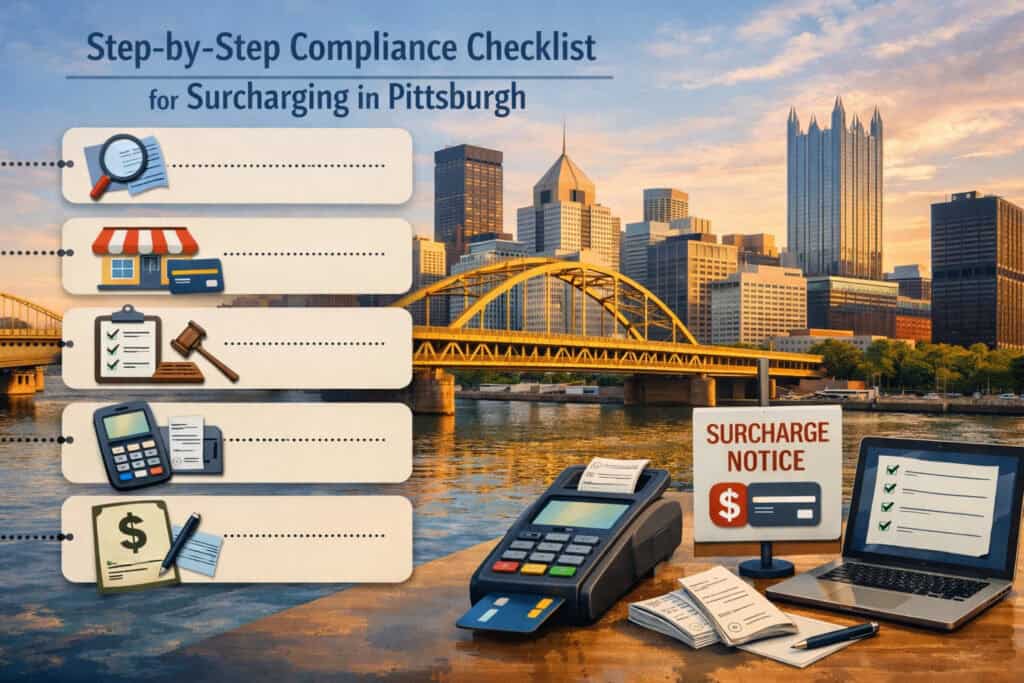
If you want surcharging in Pittsburgh to survive scrutiny, implement it like a project: plan, configure, disclose, document, then launch.
- Confirm your business model and channels: In-person retail, phone orders, invoices, online checkout, subscription billing—each can require different disclosure placements. Surcharging in Pittsburgh works best when the fee is communicated early, repeated at checkout, and shown on the receipt.
- Notify the right parties before launch: Visa requires you to notify your acquirer at least 30 days before starting. Mastercard also requires advance notice to Mastercard and your acquirer at least 30 days before you implement.
In practice, your processor or acquirer may handle registration steps, but you should keep proof (screenshots, emails, tickets). - Configure your POS correctly (credit-only detection): This is the make-or-break step in surcharging in Pittsburgh. Your terminal must identify debit and prepaid BIN ranges and exclude them.
Visa is explicit: debit and prepaid cannot be surcharged, even if the customer “runs it as credit.” If your system can’t do this, your safest alternative is a true dual-price/cash-discount model that is implemented as posted pricing rather than an add-on fee. - Set a compliant rate with documentation: Visa caps at the lower of MDR or 3%. Mastercard ties caps to cost and references a maximum surcharge cap in its summary. For surcharging in Pittsburgh, document how you calculated “actual cost” and keep processor statements that support it.
- Place disclosures in all required places: Visa calls out disclosure at point of entry, point of sale/transaction, and on every receipt. Mastercard requires clear disclosure at point of interaction and on receipts. In a Pittsburgh storefront, that usually means: door/entrance sign, counter sign, and receipt line item labeled clearly.
- Train staff and standardize scripts: Customers will ask. A calm, consistent explanation reduces disputes: “We apply a small credit card surcharge to help cover processing costs; debit is not surcharged.”
This checklist approach makes surcharging in Pittsburgh durable because it addresses both the legal spirit (transparency) and the network enforcement reality.
How to Set the Right Surcharge Rate (and Prove It’s Legal)
Pricing is where surcharging in Pittsburgh can quietly drift out of compliance. The two most common errors are (1) choosing a “round” surcharge like 4% without checking caps and (2) charging more than your actual cost to accept cards.
Visa’s rule is straightforward: the surcharge must not exceed the lower of your merchant discount rate for the applicable credit card or 3%. That means if your effective cost for a card category is 2.6%, you can’t just charge 3% because it’s allowed “in general.”
Your cap becomes 2.6% in that scenario. Mastercard’s approach is cost-based as well, with a cap framework tied to the merchant’s cost of acceptance and a stated maximum surcharge cap.
To keep surcharging in Pittsburgh defensible, build a simple “rate file” and update it periodically:
- Pull your processing statements for the last 1–3 months.
- Calculate your effective cost for credit acceptance (or use the metrics your processor provides).
- Choose a surcharge rate that is at or below your cost and within network limits.
- Keep a dated record showing your calculation method.
Also decide whether you will surcharge at brand level or product level. Visa and Mastercard both allow forms of brand-level or product-level surcharging under defined rules. Most small businesses in Pittsburgh choose a simple brand-level approach because it’s easier to explain and configure.
Finally, remember the customer experience. Even if surcharging in Pittsburgh is technically compliant at 3%, you may choose a lower rate to reduce friction, increase conversion, and avoid negative reviews. The “best” surcharge rate is the one you can justify, communicate, and consistently apply without error.
Disclosures That Actually Work in Pittsburgh Stores and Online Checkouts
Disclosure is not just a legal formality—disclosure is the primary defense against chargebacks, complaints, and “I didn’t agree to this” conflicts. Surcharging in Pittsburgh should be designed so that a customer encounters the disclosure multiple times before they pay.
Visa requires that you clearly alert consumers to surcharging at the point of entry, point of sale/transaction, and on every receipt. Mastercard similarly requires clear disclosure at the point of interaction and on the receipt.
If you’re operating in Pittsburgh with mixed channels (walk-in plus online orders), you should also disclose on your website’s payment page and at the cart/checkout step.
A practical storefront pattern for surcharging in Pittsburgh:
- Entrance sign (visible before shopping): “A credit card surcharge applies to credit card purchases.”
- Counter sign (visible before tapping/inserting): “Credit card surcharge of X% applies. Debit not surcharged.”
- Receipt line item: “Credit Card Surcharge” with a dollar amount.
A practical online pattern:
- Product page or FAQ mention (early notice).
- Checkout page notice next to payment method selection (clear and unavoidable).
- Final order review showing the surcharge as a separate line item before purchase confirmation.
- Email receipt showing the surcharge line item.
Your wording matters. Avoid vague phrases like “service fee may apply” if you’re specifically doing surcharging in Pittsburgh. Be direct: it’s a credit card surcharge, the percentage, and that it only applies to credit cards.
If Pennsylvania moves toward tighter disclosure timing rules (as proposed in recent legislative language emphasizing disclosure before completion), merchants already using strong pre-payment disclosures will be positioned well.
Handling Edge Cases: Tips, Returns, Recurring Billing, and Invoices
Most compliance problems in surcharging in Pittsburgh happen in edge cases, not at a normal retail checkout. If you plan for these upfront, your program stays consistent.
Tips and gratuities
If you surcharge on tips, customers may perceive it as unfair. Consider whether your POS applies the surcharge to the total ticket or only to the base sale amount. Whatever you choose, disclose it clearly. If you do apply it to the total, your receipt should show the surcharge amount clearly, consistent with receipt disclosure expectations.
Returns and refunds
Define whether the surcharge is refunded when the transaction is refunded. Many merchants refund the surcharge to reduce disputes and improve goodwill, even if fees aren’t always recoverable.
For surcharging in Pittsburgh, consistency is key—write it into your policy and train staff. Keep in mind that confusing refund practices are a common complaint trigger.
Recurring billing and subscriptions
If you invoice monthly and apply for surcharging in Pittsburgh, disclose it in the contract, on the invoice, and in the payment link or portal. Customers should see the surcharge before they authorize payment.
For recurring transactions, consider whether you want to offer ACH or another method to reduce costs and avoid surcharge friction.
Phone orders and emailed invoices
Your “point of interaction” becomes the verbal quote or the invoice itself. Put the surcharge notice on the invoice near the total due and repeat it at the payment step. Mastercard emphasizes disclosure at the point of interaction; for invoices, the invoice is often that point.
Edge cases don’t have to derail surcharging in Pittsburgh—you just need written rules, consistent configuration, and disclosures that match the channel.
Recordkeeping, Enforcement, and What Non-Compliance Can Cost You
A lot of merchants treat surcharging in Pittsburgh as a quick switch in the POS. The risk is that enforcement doesn’t usually show up as a courtroom drama—it shows up as processor warnings, network inquiries, consumer complaints, or fines assessed through the acquirer relationship.
Visa states it actively enforces its surcharge policy and notes that acquirers of merchants caught violating rules may face fines, describing an immediate fine amount in its Q&A. Mastercard also emphasizes that nothing in its rules eliminates your obligation to comply with applicable laws and that disclosures and notice are conditions of surcharging.
To protect your business, keep a “surcharge compliance folder”:
- Proof of 30-day notices/registrations (acquirer + network as required).
- Photos/screenshots of signage placement and online checkout disclosures.
- A copy of your written surcharge policy and staff script.
- Your surcharge rate calculation worksheet and supporting processing statements.
- POS configuration notes showing debit/prepaid are excluded.
If Pennsylvania adopts stricter statutory standards focused on timing of disclosure and limiting surcharges to actual processing cost (a direction signaled by recent legislative language), the merchants with documentation and transparent practices will adapt with minimal changes.
When surcharging in Pittsburgh, documentation is not busywork. It’s how you prove you’re fair, consistent, and compliant.
Future Outlook: Where Surcharging in Pittsburgh Is Headed
Surcharging in Pittsburgh will likely face more scrutiny over time, even if it remains legal. The trend line is toward higher transparency requirements and “actual cost” alignment, driven by consumer complaints and policy debates about card acceptance costs.
Networks already require strong disclosure and cap frameworks. State lawmakers, including in Pennsylvania, have shown interest in codifying disclosure timing and limiting surcharge amounts to actual processing costs.
Here are realistic “next 12–36 months” predictions for surcharging in Pittsburgh:
- More explicit state rules: Even if Pennsylvania doesn’t ban surcharging, it may clarify disclosure timing (“before completion”) and reinforce “no more than actual cost.”
- Tighter network enforcement: Visa already describes active enforcement, consumer complaints, and mystery shopping; as surcharging becomes more common, enforcement attention tends to rise.
- Better POS automation: Expect more terminals and gateways to automatically detect debit/prepaid vs credit and apply surcharges correctly, reducing accidental violations (one of the biggest operational risks today).
- Competitive pressure toward dual pricing: Some Pittsburgh merchants may shift to posted dual pricing to avoid the perception of “junk fees,” especially in price-sensitive segments like quick-service and local retail.
The safest “future-proof” approach is to run surcharging in Pittsburgh with maximum transparency, conservative rates, clean receipts, and credit-only enforcement. If rules tighten, you won’t have to rebuild—just adjust.
FAQs
Q.1: Is surcharging in Pittsburgh legal for all businesses?
Answer: Surcharging in Pittsburgh is generally possible for many businesses, but it’s not automatically “legal for all” in a practical sense because your ability to surcharge depends on what you sell, how you sell, and whether your payment stack can comply with network rules.
The first gate is technical: can your POS or gateway reliably surcharge credit only and exclude debit and prepaid? Visa is explicit that debit and prepaid cannot be surcharged, even if a debit cardholder selects a “credit” option on the terminal.
Mastercard is also explicit that surcharges aren’t allowed on Debit Mastercard or prepaid cards. If your system can’t enforce that, your “surcharging in Pittsburgh” program is likely to create violations.
The second gate is disclosure: you must clearly tell customers before they pay. Visa requires disclosure at the point of entry and point of sale/transaction and on receipts. Mastercard requires disclosure at the point of interaction and on receipts.
If your business model includes invoices, online orders, or phone payments, you must adapt disclosure placement to those channels.
The third gate is rate compliance: your surcharge must be within caps—Visa uses the lower of MDR or 3%. Mastercard uses a cost-based cap framework and also references a maximum cap in its summary.
So, while many Pittsburgh merchants can surcharge, “legal for all businesses” really means “possible for businesses that can comply with credit-only rules, disclosures, and caps.”
Q.2: What’s the maximum surcharge I can charge in Pittsburgh?
Answer: The maximum surcharge for surcharging in Pittsburgh is not a single universal percentage, because it depends on the network rules and your actual cost.
Visa’s rule is clear: you must limit the surcharge to the lower of your merchant discount rate (MDR) for the applicable credit card or 3%, whichever is lower. That means 3% is not always allowed—if your effective rate is 2.4%, your surcharge ceiling is 2.4% for that pricing structure.
Mastercard’s summary explains that surcharge levels are capped relative to the merchant’s cost for Mastercard credit acceptance and lists a “Maximum Surcharge Cap” in its summary materials.
In real-world implementations, many merchants choose a surcharge rate that is conservative and aligns with their measured cost across credit acceptance. That reduces risk and makes it easier to defend if a customer complains or if your processor reviews your program.
For surcharging in Pittsburgh, a strong compliance approach is:
- Compute your effective cost based on processing statements.
- Select a rate that is at or below that effective cost.
- Ensure that rate is within Visa’s cap framework.
- Confirm your acquirer supports correct surcharge data handling in transactions (Visa references a dedicated data field for surcharge in its process steps).
In short, the “maximum” is the smallest number produced by (a) network caps and (b) your real processing cost. That’s how to keep surcharging in Pittsburgh both compliant and defensible.
Q.3: Do I have to notify anyone before starting surcharging in Pittsburgh?
Answer: Yes—notification is one of the most overlooked requirements in surcharging in Pittsburgh, and it’s a requirement that networks take seriously. Visa requires that you notify your acquirer at least 30 days prior to commencing surcharging.
Mastercard’s merchant guidance also states that a merchant must provide advance notice to both Mastercard and the merchant’s acquirer no less than 30 days before implementing a surcharge.
In practice, your payment processor, acquiring bank, or payment facilitator often manages the workflow, but you shouldn’t assume it’s automatic. You want written proof that the notice was completed and accepted, because if there’s a complaint later, “we thought the processor did it” is not a strong defense.
A common compliance site summarizes the expectation that merchants must notify card brands and their processor/acquirer at least 30 days in advance and must surcharge credit only. While you should rely primarily on the networks’ own guidance, this kind of reminder reflects what many acquirers operationalize.
So if you’re planning surcharging in Pittsburgh, put “30-day notice” at the top of your project plan. Submit the required notices, keep confirmation records, and do not flip the switch early.
Q.4: How should I display signage and receipts for surcharging in Pittsburgh?
Answer: For surcharging in Pittsburgh, signage and receipts are not optional extras—they’re core compliance controls. Visa requires that you clearly alert consumers to the practice at the point of entry, the point of sale or transaction, and on every receipt.
Mastercard requires clear disclosure at the point of interaction, including the amount of the surcharge, and the dollar amount on the receipt.
In a typical Pittsburgh storefront, “point of entry” means before the customer is committed—usually at the entrance door or immediately inside where it’s visible. “Point of sale” means where the customer pays—countertop sign, terminal display, or both.
The receipt should show the surcharge as a separate line item so the customer can see the fee amount clearly.
A simple best-practice format for surcharging in Pittsburgh:
- Entrance sign: “Credit card surcharge applies to credit card purchases.”
- Checkout sign: “Credit card surcharge of X% applies to credit card purchases. Debit cards are not surcharged.”
- Receipt line: “Credit Card Surcharge — $Y.YY”
For online orders, your “signage” becomes on-screen notice: show it on the payment page and in the final order review before purchase confirmation. Then include it on the emailed receipt too.
If Pennsylvania adopts stricter statutory language emphasizing disclosure “before completion” (a direction signaled in proposed text), strong pre-payment disclosure placement will align well with future requirements.
Q.5: What’s the biggest mistake Pittsburgh merchants make with surcharging?
Answer: The biggest mistake in surcharging in Pittsburgh is accidentally surcharging debit and prepaid cards. It usually happens because the POS is set to apply a surcharge whenever a customer uses “a card,” without reliably distinguishing credit from debit/prepaid.
That’s a direct violation of network rules. Visa is clear: surcharging applies to credit cards only, and debit and prepaid cannot be surcharged—even if the cardholder selects “credit” on the terminal. Mastercard also says surcharges are not allowed on Debit Mastercard or prepaid cards.
The next most common mistake is weak disclosure. Merchants may put a small note on a receipt but fail to disclose at the entrance and checkout. Visa requires disclosure at point of entry, point of sale/transaction, and on receipts.
Mastercard requires disclosure at the point of interaction and on receipts. Customers who feel surprised are more likely to complain, dispute, or leave negative reviews, which can trigger attention from processors and networks.
A close third mistake is charging a “standard 3%” even when the merchant’s real cost is lower. Visa caps at the lower of MDR or 3%. So a flat 3% can become non-compliant depending on your pricing and card mix.
If you want surcharging in Pittsburgh to run smoothly, solve these three risks first: credit-only enforcement, strong disclosures, and a documented, compliant rate.
Conclusion
Surcharging in Pittsburgh can be legal, practical, and profitable—but only when it’s implemented with discipline. The cleanest, lowest-risk approach is simple: surcharge credit only, notify your acquirer and relevant networks in advance, keep the surcharge within your actual cost and network caps, and disclose the fee clearly before the customer pays and on the receipt.
Visa’s guidance highlights the 30-day acquirer notice, credit-only restriction, 3%/MDR cap, and multi-step disclosure expectations. Mastercard’s guidance reinforces advance notice, credit-only limitations, and strong disclosure requirements, with caps tied to cost.
If Pennsylvania moves toward more explicit statutory rules around disclosure timing and limiting surcharges to actual processing cost, merchants already practicing transparent, documented surcharging in Pittsburgh should be well positioned to adapt without disruption.