
Running a business in Pittsburgh means you’re serving a mix of neighborhoods, customer habits, and industries—Downtown offices and event venues, Strip District retail, Oakland healthcare and education, and restaurant-heavy corridors in Lawrenceville and Shadyside.
Your payments setup has to keep up with all of it: fast checkout, reliable deposits, fair rates, modern checkout options, and strong fraud protection. Choosing the right merchant services provider in Pittsburgh isn’t only about getting a “good rate.”
It’s about finding a partner that fits how you sell today (in-person, online, invoices, subscriptions, delivery) and how you’ll sell next year.
A strong merchant services provider should help you accept cards and digital wallets smoothly, reduce unnecessary fees, prevent chargebacks, and stay compliant with card-network rules and data security expectations.
Pittsburgh businesses also need to think about practical local realities—like seasonal event spikes, tourism weekends, college move-in surges, and the fact that sales tax in Pittsburgh is commonly 7% (state plus county), which affects how you configure checkout, receipts, and reporting.
This guide breaks down what to evaluate, which questions to ask, common pricing traps, and how to match a merchant services provider in Pittsburgh to your business model—plus what’s changing in payments and what to plan for next.
Understanding Pittsburgh’s payments landscape

Pittsburgh’s economy combines “steady repeat” industries (healthcare, education, professional services) with high-velocity categories (food service, bars, events, local retail, home services). That mix matters, because your merchant services provider in Pittsburgh should support the way money flows in your specific category.
Restaurants often need handheld ordering, tip adjustment, next-day funding, and strong dispute tools. Retail needs barcode inventory integrations, omnichannel returns, and reliable hardware. Service businesses need invoicing, deposits, recurring billing, and lower-risk card-not-present acceptance.
Another Pittsburgh-specific reality is that many businesses operate both inside and outside the city—think pop-ups at markets, vendor booths at festivals, catering, and mobile services across Allegheny County.
That makes mobile readers, offline mode, and consistent reporting across locations more than “nice-to-haves.” It also raises the importance of transparent funding schedules and clear fee descriptions, because cash flow can swing wildly during event weekends.
Also, payment compliance isn’t abstract. You’ll want accurate tax configuration (sales tax is commonly 7% in Pittsburgh), consistent receipt formatting, and clean reconciliation that matches your accounting workflow.
A merchant services provider in Pittsburgh that understands local business patterns will proactively set you up for fewer end-of-month surprises—especially when your revenue includes tips, deposits, partial refunds, or split tenders.
Typical payment methods customers expect in Pittsburgh
Customer expectations have shifted quickly. Beyond chip cards, customers increasingly expect tap-to-pay and mobile wallets. Even many smaller neighborhood shops now see more contactless transactions than swipe.
A modern merchant services provider in Pittsburgh should support NFC contactless payments by default, not as an add-on, and should offer EMV-compliant equipment that can handle high-volume rushes without freezing.
Online and hybrid payments matter too. Restaurants and retail often need online ordering, pickup, QR menus, pay-by-link, and gift cards that work both in-store and online.
Service providers frequently need invoice payments and recurring billing. If your provider doesn’t offer these natively, you may end up paying extra for third-party tools and dealing with mismatched reporting.
Finally, “payment choice” is also about customer trust. Transparent receipts, recognizable descriptors on bank statements, and consistent refund experiences reduce disputes.
A good merchant services provider in Pittsburgh should help you configure descriptors, email/SMS receipts, and clear refund policies—because these small details can reduce chargebacks and keep reviews positive.
Industries that often need specialized merchant services
Different Pittsburgh industries have very different risk profiles and compliance needs. Healthcare-adjacent businesses often need patient-friendly billing flows, partial payments, and secure storage policies, and the broader healthcare payments environment continues to emphasize security and privacy concerns.
Nonprofits and membership organizations frequently rely on donations, recurring contributions, and event ticketing—and their revenue can be sensitive to broader funding shifts, which makes predictable fees and strong donor UX important.
Restaurants and bars need tip workflows and stable weekend uptime. Contractors and home services need deposits, invoices, and mobile acceptance in basements and job sites. Professional firms need client portals, card-on-file, and clean bookkeeping.
A strong merchant services provider in Pittsburgh won’t push a one-size-fits-all plan. Instead, they’ll help you choose the right mix of hardware, gateways, fraud tools, and funding options based on how you sell and how your customers pay.
What a merchant services provider actually does (and what to insist on)

A merchant services provider in Pittsburgh typically connects you to the payment ecosystem: the card networks, acquiring banks, payment gateways, and risk controls that allow you to accept card payments.
But the practical difference between providers is how they package it—pricing structure, equipment terms, support quality, and whether they act as a true partner or just a reseller.
At minimum, your provider should offer: card acceptance (EMV + contactless), settlement and deposits, a reporting dashboard, dispute/chargeback handling, and basic fraud tools for online payments.
But “minimum” isn’t good enough for most Pittsburgh businesses. You should insist on transparency about fees, predictable funding, and support that actually answers when you call during a Saturday rush.
You should also insist on clear documentation. If a provider can’t give you a written fee schedule, a sample statement, and the exact contract terms, that’s a red flag.
Choosing a merchant services provider in Pittsburgh is often a multi-year decision, and most long-term regret comes from vague language: “as low as” rates, hidden equipment leases, and fees that show up only after month two.
Key payment components: processor, gateway, POS, and acquiring
One common source of confusion is that a “merchant services provider in Pittsburgh” may be bundling multiple vendors. The processor handles routing and settlement. The gateway supports online acceptance and tokenization.
The POS manages checkout, receipts, and often inventory. The acquiring relationship is the bank-side piece that actually settles card funds to your business.
Why does that matter? Because when something breaks—declines spike, your website checkout fails, deposits delay, chargebacks increase—you need to know who owns the problem. The best providers own the full stack (or coordinate it cleanly) and don’t bounce you between three support teams.
A practical way to evaluate this is to ask: “Who provides the gateway? Who provides the POS? Who provides the hardware? Who is the acquiring bank? If we have an outage, who is accountable?” A reliable merchant services provider in Pittsburgh will answer clearly and in writing.
Funding timelines and cash-flow realities for local businesses
Funding is where many Pittsburgh businesses feel pain. Next-day or same-day funding can be valuable, but it’s not always necessary—and sometimes it comes with extra fees or stricter risk holds. What matters most is predictability: knowing exactly when money hits your bank and what conditions can delay it.
Ask for the provider’s standard deposit schedule, cut-off times, and hold policies for large tickets, keyed transactions, refunds, or unusual volume spikes (like a festival weekend).
If your business is seasonal or event-driven, you want a merchant services provider in Pittsburgh that can pre-plan risk thresholds instead of freezing funds unexpectedly.
Also confirm how tips are handled. Many restaurants adjust tips after authorization, which affects batching and settlement. If the provider’s system handles tip adjustment poorly, you can get reconciliation headaches and unhappy staff. Good providers help you set tip prompts, tip reporting, and payout timing correctly from day one.
Pricing models explained (so you can compare providers correctly)
Pricing is where sales pitches get slippery. A merchant services provider in Pittsburgh can advertise a low “rate,” but your true cost depends on your transaction mix: debit vs credit, rewards cards, card-present vs online, average ticket size, refunds, chargebacks, and monthly volume. Two businesses can have the same “rate” and totally different effective costs.
To compare providers fairly, you need to understand the common pricing structures and what to ask for. You should also insist on seeing a sample statement that shows all fees, not just the headline percentage.
When you evaluate a merchant services provider in Pittsburgh, treat the statement like a lease agreement: the truth is always in the fine print.
Interchange-plus vs tiered vs flat-rate pricing
Interchange-plus is often the most transparent: you pay the card’s underlying interchange cost plus a fixed markup. It can be cost-effective for established businesses with stable volume because you can see what’s going where.
Tiered pricing buckets transactions into “qualified/mid-qualified/non-qualified” (or similar). This is often harder to audit, because the provider controls the tiers, and more transactions tend to fall into higher-cost buckets than you expect.
Flat-rate pricing (one percentage + fixed fee) is simpler and can be great for startups, low volume, or businesses that value simplicity over optimization. But it may become expensive at scale, especially for card-present debit-heavy businesses.
A practical approach: ask each merchant services provider in Pittsburgh to estimate your monthly fees using your last 2–3 months of statements (or realistic projections if you’re new). Then compare effective rate and total monthly cost, not marketing numbers.
Common fees that show up after you sign
Many merchants focus on the processing rate but miss the “small” fees that add up: monthly account fees, PCI/non-compliance fees, statement fees, gateway fees, batch fees, regulatory fees, AVS fees for online sales, chargeback fees, and minimum monthly fees.
Equipment is another big one. If a merchant services provider in Pittsburgh pushes a long-term equipment lease, be cautious. Leasing can lock you into paying far more than the hardware’s value, and it can be hard to cancel.
Prefer buying hardware outright or using a month-to-month hardware plan with clear replacement terms.
Finally, watch for “rate increases” tied to vague triggers. If your contract allows unilateral increases with little notice, you’re not getting a partnership—you’re getting a risk transfer.
Compliance, surcharging, and cash discounting in Pennsylvania
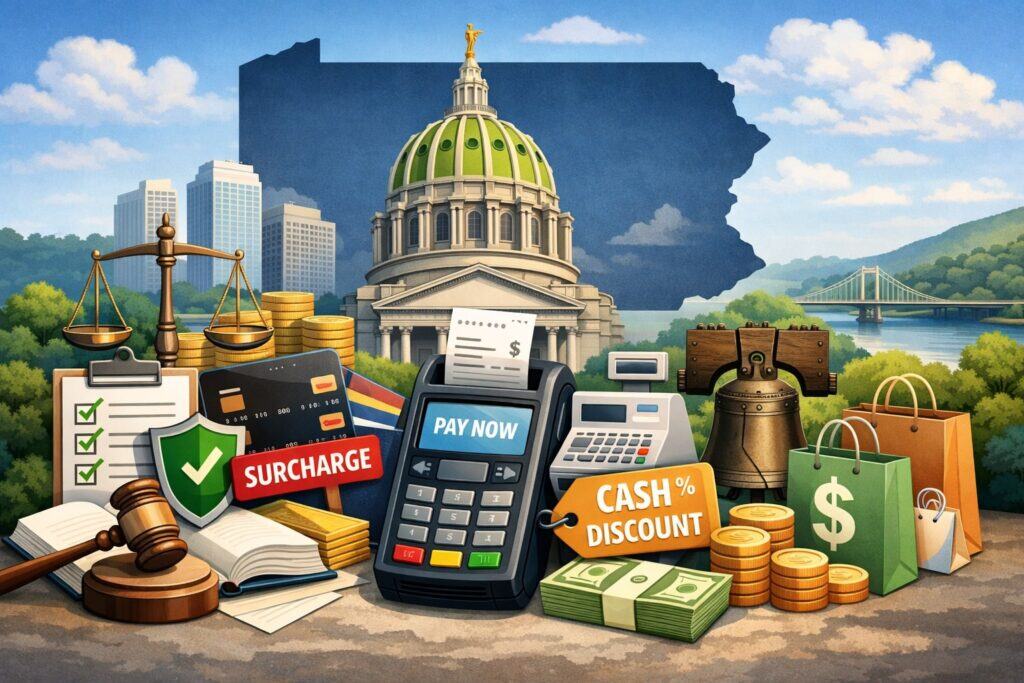
Pittsburgh merchants frequently ask about offsetting processing costs through surcharging or cash discounting. Done correctly, these programs can reduce your net fees. Done poorly, they can create customer backlash, disputes, and compliance trouble.
Card brand rules and state-level requirements can evolve, so your merchant services provider in Pittsburgh should be able to explain current requirements, provide compliant signage/receipt formatting, and help you implement it correctly.
Industry guidance emphasizes that surcharging generally applies only to credit cards (not debit), and proper disclosure is critical.
Pennsylvania lawmakers have also considered rules focused on surcharge disclosure and limiting surcharges to actual processing cost, which is exactly the type of change a provider should monitor for you.
If your provider treats these topics casually, that’s a red flag—because the cost of getting it wrong can exceed the savings.
Surcharging vs cash discounting: what’s the difference?
A surcharge is an added fee for paying with a credit card, typically disclosed before purchase. A cash discount is framed as a discount from a listed price when the customer pays with cash (or another non-card method).
The distinction matters because the legal and card-network treatment differs, and the implementation details (signage, receipts, POS configuration) are not optional.
Practical merchant guidance stresses that disclosure and proper setup matter, including POS programming and receipt formatting. If you’re considering either approach, choose a merchant services provider in Pittsburgh that has implemented these programs at scale and can provide compliant templates and training.
Also, consider customer experience. In some neighborhoods and industries, adding a card fee can reduce conversion or trigger negative reviews. In others, customers accept it if it’s clearly communicated and modest. A good provider will help you model the financial benefit and the brand impact.
Practical compliance checklist for Pittsburgh merchants
A useful checklist to discuss with any merchant services provider in Pittsburgh:
- Confirm whether the program applies only to credit (not debit) and how the POS distinguishes them.
- Confirm disclosure requirements: signage at entry/checkout, on the website checkout page, and on receipts.
- Confirm limits: surcharge should not exceed actual processing cost, and policies may evolve.
- Confirm refund handling: if you refund a sale, how are fees handled and what happens to the surcharge/discount?
- Train staff on how to explain it in one sentence without sounding defensive.
If your provider can’t walk you through these points clearly, pick a different merchant services provider in Pittsburgh—because the “savings” won’t be worth the operational risk.
Hardware and POS choices for Pittsburgh storefronts and mobile businesses
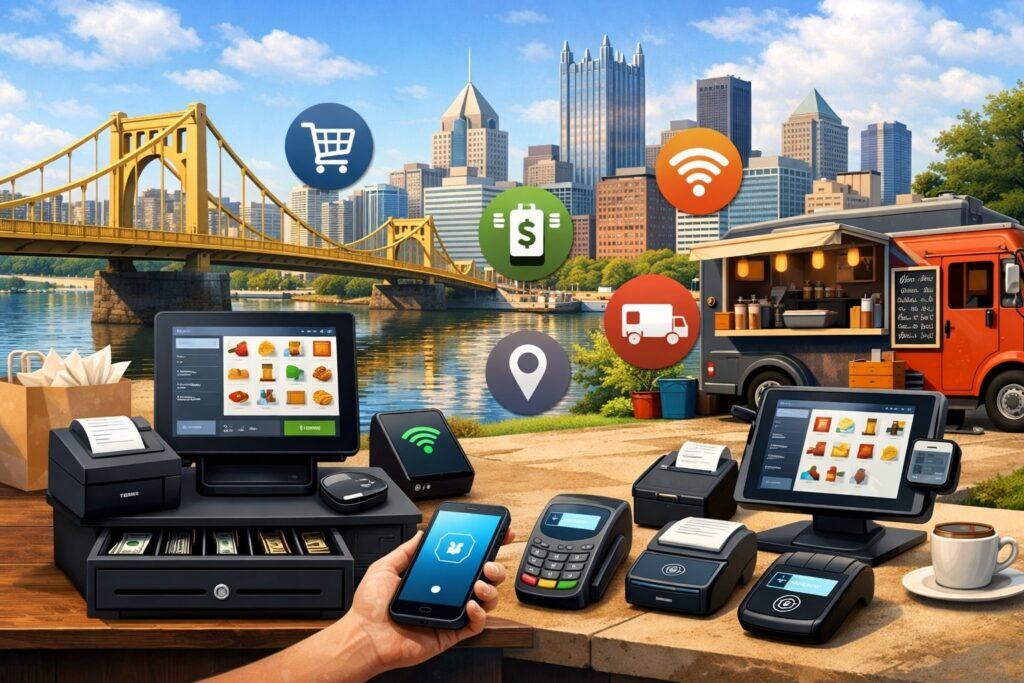
Hardware is where theory meets reality. The wrong device slows lines, increases failed transactions, frustrates staff, and makes customers think your business is less modern than it is.
A strong merchant services provider in Pittsburgh should start by asking how you sell before recommending hardware: counter checkout, tableside, curbside, delivery, pop-ups, job sites, or multi-location.
You should expect EMV + contactless support, quick receipt options (digital and printed), and strong uptime. If you run a café or bar, speed matters. If you’re mobile, connectivity matters.
If you’re retail, barcode scanning and inventory integration may matter. Hardware is not just a one-time purchase—it’s a workflow decision that affects labor, throughput, and customer satisfaction.
Also think about durability and replacement. Pittsburgh winters are rough on mobile setups. If you do outdoor events, terminals get dropped, wet, and bumped. Ask what happens when a device fails on a weekend and whether replacements are overnighted.
POS integrations that matter: accounting, inventory, online ordering
Most businesses don’t want “another dashboard.” They want payments to reconcile cleanly into their bookkeeping. A good merchant services provider in Pittsburgh should support integrations with common accounting tools and provide exports that match deposit batches, fees, refunds, and tips. Otherwise, you’ll waste hours every month just proving where the money went.
Retail and hospitality often need inventory or menu management and online ordering. If your POS and online ordering aren’t unified, you risk overselling items, confusing customers, and generating refunds. For hybrid sellers, unified gift cards and loyalty can also be a competitive advantage in neighborhood markets.
When evaluating a merchant services provider in Pittsburgh, ask for a demo that shows the end-to-end flow: sale → tip → close batch → deposit → refund → report → accounting export. Demos that only show a card tap are not enough.
Mobile and event payments in Pittsburgh: offline mode and cellular reliability
Mobile payments are essential for many Pittsburgh businesses: food trucks, vendors, home services, and pop-ups. The key feature here is not just “a mobile reader,” but a system designed for unreliable connectivity. Offline mode can allow transactions to queue temporarily, though it may increase risk and isn’t appropriate for every business.
A capable merchant services provider in Pittsburgh will help you decide safe offline limits, suggest best practices (like verifying high tickets), and ensure your reporting doesn’t break when you run both mobile and in-store operations. They’ll also advise on receipts and proof-of-delivery practices that reduce disputes after events.
This matters because event payments tend to create “spiky” volume that triggers risk flags. Pre-planning these spikes with your provider can reduce deposit delays.
Fraud prevention, chargebacks, and security you can actually use
Fraud tools are only useful if they fit your operation. Pittsburgh businesses that do online ordering, delivery, or invoicing are especially exposed to card-not-present fraud. Even card-present businesses can face chargebacks from “I don’t recognize this charge” disputes, especially if your descriptor is unclear or your refund policy is inconsistent.
A strong merchant services provider in Pittsburgh should provide practical tools: address verification (AVS), CVV checks, velocity controls, 3DS for higher-risk e-commerce, and clear dispute workflows.
But they should also help you reduce friendly fraud—customers disputing legitimate charges—through better receipts, consistent descriptors, and clear customer communication.
Security also includes data handling. You want tokenization (so you’re not storing card numbers), role-based access controls, and secure user permissions for staff. If your provider can’t explain how it protects card data and reduces your scope, keep shopping.
Chargeback management: what good providers do differently
Many merchants only learn chargebacks when one hits. A better merchant services provider in Pittsburgh helps you prepare: they provide templates for evidence, recommended refund policies, and alerts that allow you to respond quickly.
They should also help you track root causes. Are disputes coming from online orders without proof of fulfillment? From unclear descriptors? From subscription cancellations? From tips? Effective chargeback reduction is often operational, not technical.
Ask whether the provider offers representation support, integrations with chargeback tools, and clear guidance on what evidence works (delivery confirmation, signed receipts, customer communication logs). Also confirm chargeback fees and whether you can reduce them through proactive prevention.
PCI, data security, and staff controls
Payment data security is an ongoing responsibility. While many providers help reduce PCI scope through tokenization and hosted fields, you still need good practices: unique logins, staff permission controls, secure Wi-Fi, and regular device checks.
Industry guidance also emphasizes clear disclosure and compliance when implementing pricing programs like surcharging or cash discounting—because payment compliance isn’t only “tech,” it’s also communication and process.
A reliable merchant services provider in Pittsburgh should provide an easy PCI path (not a confusing portal that triggers surprise “non-compliance” fees) and should train you on simple operational security steps that actually prevent problems.
How to evaluate providers: a Pittsburgh-specific checklist
If you want to choose confidently, you need a structured evaluation. Many merchants compare only the headline rate, then discover support gaps, equipment lock-ins, or deposit holds. A better method is to score each merchant services provider in Pittsburgh across pricing, contract terms, support, technology, and fit for your business model.
Start by collecting your last 2–3 processing statements (or your projected ticket size and volume). Then ask each provider to produce a side-by-side cost estimate under the pricing model they recommend. Ask for a sample contract, cancellation terms, and a written list of all monthly/annual fees.
Also look at local support reality. If your Saturday-night terminal fails, will you reach a real technician? Will they overnight hardware? Will they blame your internet and hang up? These are practical questions that matter more than a difference of a few basis points.
Finally, consider growth. If you plan to add locations, launch online ordering, or offer subscriptions, your provider should support that path without forcing you into a costly migration.
Questions to ask before signing (and what good answers sound like)
Ask any merchant services provider in Pittsburgh:
- “What is the full fee schedule, including monthly fees, gateway fees, batch fees, PCI fees, and chargeback fees?”
- “Is pricing interchange-plus? What is the markup and is it fixed?”
- “What’s the funding timeline and what can trigger a hold?”
- “Do you have month-to-month terms? What are cancellation fees?”
- “Who provides the gateway and POS, and who is accountable if it breaks?”
- “What’s your process for disputes and chargeback responses?”
- “If we want surcharging or cash discounting, how do you ensure compliant disclosure and receipts?”
Good answers are specific, written, and consistent. Bad answers are vague, rushed, and full of “usually” and “should be.”
Red flags that Pittsburgh merchants commonly overlook
The biggest red flags aren’t always obvious:
- Long, non-cancellable equipment leases
- “Intro rates” that increase after a short period
- Tiered pricing that’s hard to audit
- PCI non-compliance fees that are easy to trigger
- Support that’s outsourced with no escalation path
- Providers that won’t give you sample statements or full terms in writing
If a merchant services provider in Pittsburgh avoids specifics, that’s a signal. Payments is a regulated, operationally critical function—reliable partners are comfortable with transparency.
Future-proofing your payment setup in Pittsburgh
Payments are changing fast. Over the next few years, more customers will default to contactless and mobile wallets, more commerce will be hybrid (in-store + online), and more businesses will adopt real-time payment options for invoices and B2B flows.
Your merchant services provider in Pittsburgh should help you prepare for those shifts without constant platform changes.
One key trend is the rise of account-to-account and faster payments options for some use cases. Another is growing attention on fee transparency—both from customers and policymakers.
Pennsylvania has seen legislative attention toward disclosure and limits around surcharges, which suggests ongoing scrutiny in this area. Providers that track changes and adjust your setup proactively reduce risk.
Also expect fraud patterns to keep evolving. As more transactions move online and into wallets, dispute behavior changes too. The best providers will offer flexible fraud controls, alerts, and analytics that help you tune risk without blocking legitimate customers.
What to plan for in 2026–2028: trends and practical predictions
Here are practical, business-friendly predictions you can plan around:
- Contactless as default: Most customers will expect tap-to-pay everywhere; older swipe-only terminals will feel “broken.”
- More omnichannel expectations: Customers will want to buy online and return in-store, or order ahead and pick up.
- Greater fee transparency pressure: Businesses will face more customer scrutiny on fees and pricing programs; clear signage and receipts become brand protection.
- Faster settlement options expand: More providers will offer faster funding and alternative payout tools, but terms will vary by risk profile.
- More automation in reconciliation: Better integrations and smarter reports will become a competitive advantage for operators who hate bookkeeping.
Choosing a merchant services provider in Pittsburgh that invests in upgrades and provides an upgrade path (without forcing migrations) is one of the smartest long-term decisions you can make.
Building a scalable payments stack without constant switching
The easiest way to avoid switching providers every two years is to choose a stack that can expand:
- Start with the right pricing model for your volume
- Pick hardware/POS that supports both in-store and mobile
- Ensure your gateway supports tokenization and easy online expansion
- Confirm that reporting exports match your accounting workflow
- Get contract terms that don’t punish growth or change
If your merchant services provider in Pittsburgh can’t show you how you’ll add online ordering, invoicing, or additional locations, they may not be the right long-term partner.
FAQs
Q.1: What’s the biggest mistake businesses make when choosing a merchant services provider in Pittsburgh?
Answer: The most common mistake is choosing based only on the advertised rate. A low headline number doesn’t reflect your real monthly costs once you include monthly fees, gateway fees, batch fees, chargeback fees, and equipment expenses.
Many merchants also don’t compare funding timelines and hold policies—then discover their deposits are delayed during high-volume periods. A better approach is to compare total cost using your real transaction mix and a sample statement, then score each merchant services provider in Pittsburgh on transparency, support, and fit.
Also, many merchants accept equipment leases without understanding the total payoff cost. If the provider won’t offer month-to-month terms or clear cancellation language, that’s a sign to slow down and keep shopping.
Q.2: Is interchange-plus always better than flat-rate pricing?
Answer: Not always. Interchange-plus can be more transparent and cost-effective at scale, but flat-rate can be simpler and predictable for new or low-volume businesses. The right choice depends on your average ticket, monthly volume, and how much you value simplicity.
A good merchant services provider in Pittsburgh will run both scenarios using your real data and show you the total monthly cost difference instead of pushing one model.
The key is getting everything in writing: markup, monthly fees, and any “extras” like gateways or chargeback tools. Without that, you’re not comparing fairly.
Q.3: Can Pittsburgh businesses use surcharging or cash discounting legally?
Answer: Many businesses use these programs, but the details matter. Guidance commonly emphasizes that surcharges apply to credit cards (not debit) and that disclosure is essential. Cash discount programs must also be structured and communicated properly so they aren’t treated like an improper surcharge.
Pennsylvania has also seen legislative attention on surcharge disclosure and limits tied to actual processing cost, which is a reason to stay updated and work with a provider that treats compliance seriously.
Always consult qualified counsel for final legal advice, but operationally, you should only implement these programs through a merchant services provider in Pittsburgh that can provide compliant signage, receipt formatting, and staff training.
Q.4: What sales tax rate should I configure in Pittsburgh?
Answer: Many references list Pittsburgh’s sales tax as 7% (state plus county) for typical taxable sales, and accurate configuration is important for receipts and reporting.
Your exact tax obligations can vary by product/service category and taxability rules, so confirm specifics with a tax professional, but from a POS setup perspective, you want your merchant services provider in Pittsburgh to help ensure your checkout tax settings match how you sell.
Also ensure your reporting can separate taxable vs non-taxable categories where relevant, because that makes filing and audits much easier.
Q.5: How do I know if my provider’s support will actually be good?
Answer: Ask how support works on nights and weekends, whether you get a dedicated rep, and what the replacement process is for failed hardware. Then test them: call support during a busy time and see how quickly you reach a knowledgeable person.
A reliable merchant services provider in Pittsburgh should have clear escalation paths and should be able to troubleshoot beyond “restart the terminal.”
Also ask for local references in similar industries. If they can’t provide any, look for stronger options.
Q.6: What should I prioritize if I plan to add online ordering or invoices soon?
Answer: Prioritize a gateway and platform that supports tokenization, fraud tools, and consistent reporting across channels. Many businesses bolt on an online checkout later and end up with mismatched deposits and confusing reconciliation.
A strong merchant services provider in Pittsburgh will show you an omnichannel plan upfront—how in-store sales, online orders, pay-by-link invoices, gift cards, and refunds all show up in one reporting flow.
You should also confirm that your online checkout supports mobile wallets and that fraud tools are configurable for your risk tolerance.
Conclusion
Choosing the right merchant services provider in Pittsburgh is a strategic decision that touches revenue, customer experience, and operational sanity. The best providers combine transparent pricing, reliable funding, modern payment options (EMV + contactless + digital wallets), and real support when something breaks.
They also help you avoid costly mistakes—like equipment leases, confusing tiered pricing, and poorly implemented surcharging or cash discounting that can create compliance and reputation risk.
Start by mapping how your business actually sells: in-store, mobile, online, invoices, subscriptions, events, or all of the above. Then evaluate each merchant services provider in Pittsburgh using real statements, full fee schedules, and written contract terms.
Pay attention to funding predictability, hold policies, dispute workflows, and how well the POS and gateway integrate with your accounting and day-to-day operations.
And plan ahead: payments will continue shifting toward contactless, omnichannel commerce, and stronger transparency expectations—so choosing a partner with a clear upgrade path will protect you for years to come.