Pittsburgh neighborhood businesses thrive on relationships—regulars who stop by a corner café in Bloomfield, a boutique in Lawrenceville, a barbershop in the Hill District, or a family restaurant in Brookline.
But even the most loyal customers expect checkout to be fast, flexible, and secure. That’s why payment solutions are no longer “back office” decisions. For Pittsburgh neighborhood businesses, the right payment stack affects daily cash flow, customer experience, staffing, fraud risk, and long-term growth.
This guide breaks down practical, modern payment solutions that fit how local shops actually operate: busy weekends, seasonal swings, community events, pop-ups, delivery, and services.
You’ll learn how to choose a point-of-sale setup, accept tap-to-pay and QR payments, manage ACH and invoices, reduce chargebacks, and prepare for upcoming security and compliance shifts—without drowning in jargon.
You’ll also see neighborhood-specific considerations (tourist foot traffic, student customers, appointment-based services, and high-ticket specialty retail) and how to align payment solutions for Pittsburgh neighborhood businesses with your pricing, staff workflow, and customer expectations.
Finally, you’ll get a future-facing view: faster bank payments, stronger fraud rules for ACH, and how local businesses can stay ahead while keeping checkout friendly and simple. The goal is straightforward—help your business pick payment solutions that work today and won’t force a painful switch tomorrow.
Why Payment Solutions Matter for Pittsburgh Neighborhood Businesses
For Pittsburgh neighborhood businesses, the payment experience is part of the brand. When checkout is smooth, customers remember convenience; when it’s clunky, they remember the delay.
Modern payment solutions for Pittsburgh neighborhood businesses do more than accept cards—they shape your margins, staffing efficiency, and customer retention.
First, payments impact profitability through processing fees, chargebacks, and operational overhead. If your payments are set up poorly, you may be paying unnecessary costs via non-optimized pricing, downgraded transactions, excessive keyed-entry, or mismatched card-present versus online rates.
Strong payment solutions help you route transactions correctly (in-store vs. online), reduce manual errors, and support tip prompts, split checks, and partial refunds—critical for restaurants, cafés, and salons across Pittsburgh neighborhoods.
Second, good payment tools improve cash flow. Many neighborhood businesses operate on tight working capital, and even a 24–48 hour difference in funding can matter when you’re buying inventory, paying staff, or handling a slow week.
The right payment solutions for Pittsburgh neighborhood businesses can offer predictable deposit timing, clear reporting, and options for faster access to funds when needed—without locking you into confusing terms.
Third, customer expectations have shifted. Tap-to-pay, digital wallets, QR ordering, and online invoices are standard now. Pittsburgh’s mix of students, young professionals, long-time residents, and visitors means you need flexible acceptance methods.
That flexibility is exactly what modern payment solutions provide: a unified setup that supports in-person, online, and mobile checkout while keeping reporting consistent.
Understanding Pittsburgh’s Business Districts and How They Shape Payment Needs
Pittsburgh is a city of distinct neighborhood business districts—from corridors with dense foot traffic to calmer residential shopping streets. Your ideal payment solutions for Pittsburgh neighborhood businesses depend on where you operate and how customers behave in that area.
The Urban Redevelopment Authority’s neighborhood business districts map highlights how commercial activity is spread across many community hubs rather than one single downtown-only economy.
In high-foot-traffic areas like the Strip District and Lawrenceville, speed and line-busting matter. Customers may be tourists or first-timers, which increases the value of frictionless checkout, clear receipts, and strong dispute documentation.
In neighborhood corridors that rely on regulars—like parts of Brookline, Greenfield, or Squirrel Hill—loyalty tools, stored customer profiles (when appropriate), and consistent tipping prompts can improve repeat visits.
Business type matters just as much as geography. Restaurants need tip adjustment workflows and split payments. Retail needs barcode scanning and inventory integration. Service businesses need appointment-based deposits, invoices, and recurring billing.
Pop-ups and vendors need mobile checkout and offline modes. In Pittsburgh, many small businesses also do community events, seasonal markets, and collaborations—so portable, flexible payment solutions are often more valuable than a “one-counter” setup.
A smart approach is to pick payment solutions for Pittsburgh neighborhood businesses that match your highest-volume scenario, then ensure the same system can handle your secondary channels (delivery, invoices, events).
That prevents the common local trap of running three separate payment tools that don’t reconcile cleanly—leading to messy bookkeeping and avoidable fees.
Core Payment Options for Pittsburgh Neighborhood Businesses
The strongest payment solutions for Pittsburgh neighborhood businesses typically combine multiple rails: card payments, digital wallets, ACH, and invoicing. The key is choosing the mix that fits your average ticket size, customer preferences, risk profile, and operating hours.
Card payments (credit and debit) remain central for in-store retail and dining. EMV chip and contactless (tap) are essential not just for convenience but also for reducing counterfeit fraud. Digital wallets (like tap-to-pay via phone) improve speed and are increasingly expected by younger customers and commuters.
ACH bank transfers are useful for invoices, B2B payments, memberships, and larger-ticket services where card fees feel expensive. But ACH comes with its own risk and compliance responsibilities, and upcoming ACH security rules make it even more important to use strong monitoring and verification (more on that later).
QR payments and pay-by-link options are increasingly valuable for quick-service concepts, bars, food trucks, and event vendors—especially when you want customers to order or pay without waiting at a counter.
Meanwhile, gift cards and store credit (digital or physical) can be a powerful neighborhood loyalty driver, especially during holidays and community shopping events.
The biggest mistake is treating these as separate “add-ons.” The best payment solutions unify them into one reporting and reconciliation flow. That means your deposits, fees, tips, refunds, and chargebacks are visible in one dashboard, with clean exports to your accounting tools.
For Pittsburgh neighborhood businesses, that visibility is often the difference between feeling in control of cash flow and constantly playing catch-up.
Choosing the Right POS System in Pittsburgh Neighborhoods
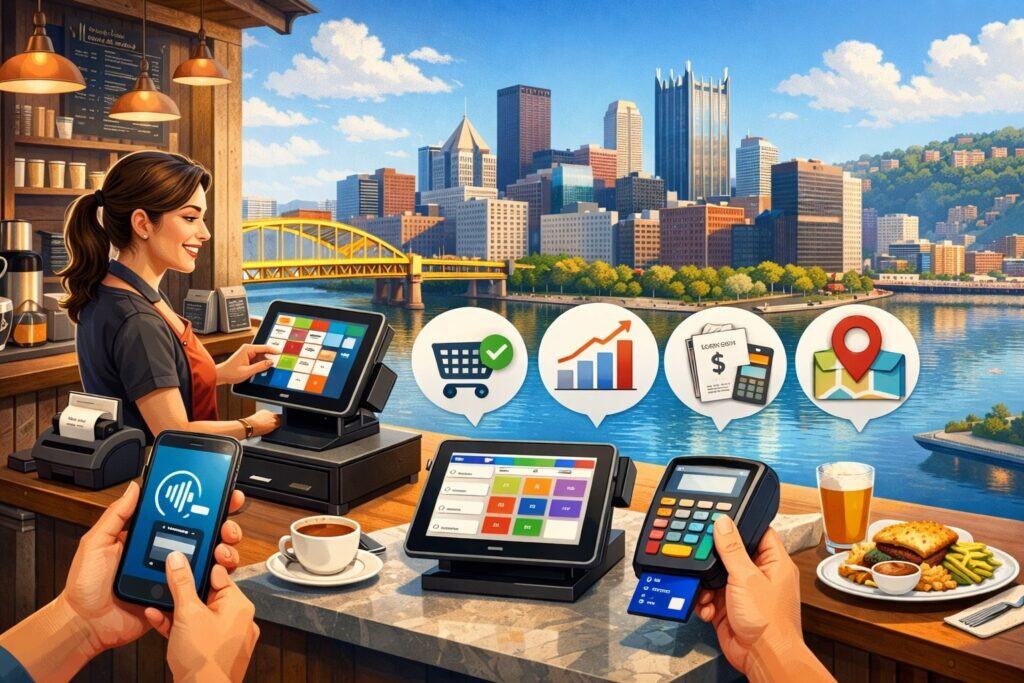
A point-of-sale system is more than a checkout screen—it’s the operational heart of many payment solutions for Pittsburgh neighborhood businesses. The right POS reduces training time, prevents pricing mistakes, speeds up service, and makes reporting easier when you’re juggling multiple locations or channels.
Start by separating needs into three layers: (1) payments acceptance, (2) operations (inventory, modifiers, appointments), and (3) analytics (sales reports, staff performance, product mix).
Neighborhood restaurants often need table management, coursing, item modifiers, and tip workflows. Retailers want barcode scanning, vendor catalogs, purchase orders, and return handling. Service businesses want appointments, deposits, no-show fees, and memberships.
Hardware choice is a neighborhood reality. Some Pittsburgh storefronts have tight counters, limited storage, or older building layouts. If your space is small, a tablet-based POS with a compact contactless reader may be ideal.
If your staff needs to take payments at the table or on the floor, handheld devices can be worth the investment—because labor savings and faster turns can offset hardware costs. If you run pop-ups, consider mobile POS with cellular connectivity and offline fallback.
Integration matters for long-term sustainability. Many Pittsburgh neighborhood businesses rely on quick bookkeeping and local accountants; choose payment solutions that integrate smoothly with accounting software and payroll tools.
That reduces errors and helps you handle sales tax reporting more reliably. (Pittsburgh’s combined sales tax rate is commonly cited as 7%, driven by state and county components, so accurate POS tax setup is important when you sell taxable goods.
Card Processing Pricing Models and How to Avoid Cost Traps
Understanding pricing is one of the fastest ways for Pittsburgh neighborhood businesses to improve margins. Many owners focus on the quoted “rate,” but real cost depends on how transactions are run and how fees are structured.
Good payment solutions for Pittsburgh neighborhood businesses make pricing transparent and help you avoid hidden add-ons.
Common pricing structures include interchange-plus, tiered pricing, and flat-rate pricing. Interchange-plus is often more transparent because it separates the underlying card network costs from the processor’s markup.
Tiered pricing can be harder to audit because transactions are grouped into buckets that may not reflect your actual risk and card mix. Flat-rate pricing can be simple for new or low-volume businesses, but it can become expensive as volume grows or when you process a lot of debit transactions.
Cost traps often show up in the details: monthly minimums, PCI fees, statement fees, “non-qualified” tiers, higher keyed-entry rates, and equipment leases. For neighborhood businesses with thin margins, these extras can quietly erase profits.
The best payment solutions include clear monthly statements, easy-to-export reporting, and tools to reduce downgrades (for example, ensuring you capture the right data for card-not-present orders and avoid manual entry whenever possible).
You should also match acceptance methods to your business model. If most of your sales are in-person, push customers toward contactless or chip rather than keyed entry.
If you invoice larger jobs, consider ACH options for repeat clients to reduce processing cost—while adding appropriate verification steps to reduce fraud risk. These choices are part of modern payment solutions for Pittsburgh neighborhood businesses, and they can meaningfully impact your net income month after month.
Contactless, Digital Wallets, and QR Payments in Neighborhood Commerce
Contactless payments aren’t just a trend—they’re a baseline expectation in many Pittsburgh corridors where customers want quick transactions, minimal friction, and modern checkout.
Strong payment solutions for Pittsburgh neighborhood businesses should support tap-to-pay (NFC), mobile wallets, and QR-based flows without forcing awkward workarounds.
Tap-to-pay is especially powerful for cafés, bakeries, quick-service lunch spots, and event vendors. It speeds up lines and reduces the chance of abandoned purchases during busy moments.
Mobile wallet users also tend to prefer digital receipts and fast checkout, which makes your receipt and customer communication settings surprisingly important.
QR payments can be used in multiple ways: pay-at-table, order-ahead, pay-by-link, or donation-style tipping. In busy neighborhoods with limited space, QR ordering reduces congestion at the counter and can help staff focus on service rather than transaction handling.
For bars and casual dining, QR can support split bills more easily—each person pays their share without complex register gymnastics.
That said, you should implement these tools thoughtfully. Overcomplicated QR menus can frustrate customers who prefer simple human interaction. The best payment solutions offer QR as an option, not a forced gate. Train staff to recognize when a customer wants quick tech-enabled checkout versus a traditional experience.
For Pittsburgh neighborhood businesses, especially those built on community feel, the winning approach is “modern but warm.” Your payment solutions for Pittsburgh neighborhood businesses should feel invisible when everything works—fast, secure, and friendly—without turning your shop into a self-checkout warehouse.
Online Payments, Delivery, and Omnichannel Consistency
Even businesses that think of themselves as “in-person” increasingly rely on online ordering, delivery, and pay-ahead pickup. That means payment solutions for Pittsburgh neighborhood businesses must handle omnichannel sales without creating accounting chaos.
A common problem is running in-store payments through one system and online orders through another. That leads to mismatched deposits, inconsistent reporting categories, and a messy end-of-month close.
The best payment solutions use a unified platform or tight integrations so that sales, tips, refunds, and customer records stay coherent.
For restaurants, online ordering should connect to the same menu database as your POS, so modifiers and pricing stay aligned. For retail, online inventory syncing prevents overselling.
For service businesses, online booking should connect to deposits, cancellation fees, and invoicing. Consistency reduces staff confusion and avoids customer frustration (“Why is the online price different?”).
Security also changes online. Card-not-present transactions have higher fraud risk than in-person chip transactions. Strong payment solutions for Pittsburgh neighborhood businesses include fraud tools like address verification (AVS), CVV checks, velocity rules, and clear dispute documentation.
They also support customer-friendly features like saved payment methods (with proper tokenization), subscriptions, and digital receipts.
Omnichannel doesn’t mean “do everything.” It means doing the channels you choose well, with consistent reporting and a predictable customer experience. For Pittsburgh neighborhood brands, that consistency builds trust—customers know what to expect whether they’re paying at the counter, on a phone, or through an invoice link.
ACH, Invoicing, and Bank-to-Bank Payments
ACH and invoicing are often underused tools for Pittsburgh neighborhood businesses, especially those with B2B clients, memberships, or higher average tickets. If you run catering, home services, professional services, studios, or recurring programs, ACH can reduce processing costs compared with cards—while offering a familiar “bank transfer” experience.
But ACH is not “set it and forget it.” Fraud patterns have increased across digital payments, and ACH in particular is seeing new operational expectations.
Nacha has announced upcoming rule changes with compliance timelines in 2026, emphasizing stronger fraud monitoring and risk management for ACH originators. Some summaries also discuss broader compliance expectations tied to mid-2026 dates.
Practically, this means your payment solutions for Pittsburgh neighborhood businesses should support: bank account verification (instant or micro-deposit), monitoring for suspicious activity, clear authorization capture, and good recordkeeping.
For invoices, you want easy payment links, automated reminders, partial payments, and clean reconciliation into your accounting workflow.
Bank-to-bank payments are also evolving. Faster payments options (including real-time rails offered by financial institutions) are becoming more accessible to small businesses. Over time, Pittsburgh neighborhood businesses may increasingly accept faster bank payments for invoices and large-ticket purchases, especially when customers prefer avoiding card limits or fees.
The future direction is clear: faster settlement, better confirmation, and more robust fraud controls. Your goal is to adopt payment solutions that can add these rails without forcing a complete system overhaul.
Managing Sales Tax, Tips, and Neighborhood-Specific Checkout Policies
Payment setup isn’t only about taking money—it’s about collecting it correctly and documenting it properly. For Pittsburgh neighborhood businesses, this often comes down to sales tax configuration, tipping workflows, and customer-friendly policies that reduce disputes.
If you sell taxable items, your POS needs accurate tax rules and clear receipt formatting. Pittsburgh’s combined sales tax rate is commonly cited as 7% (driven by state and county rates), and while your exact obligations depend on what you sell, misconfiguring tax in your POS can create painful reconciliation and filing issues.
Your payment solutions for Pittsburgh neighborhood businesses should let you define tax categories (taxable vs. non-taxable), apply tax correctly, and generate reports that match what your bookkeeper needs.
Tips are another critical operational detail. Restaurants, cafés, delivery teams, salons, and barbershops need tip prompts that fit their service model. Consider whether you want tipping on the screen, on printed receipts, or via QR links. Ensure your system supports tip adjustments and tip pooling rules that match your payroll practices.
Policies reduce friction. Clear refund terms, receipt options, and dispute-friendly documentation help prevent chargebacks. If you do deposits (appointments, catering), make sure your payment flow captures authorization and terms clearly.
For neighborhood businesses that rely on reputation, the goal is to stay fair and flexible while protecting yourself from avoidable losses. That balance—customer-friendly but operationally tight—is what strong payment solutions make easier.
Security, PCI Compliance, and Fraud Prevention for Small Businesses
Security is not optional, and modern fraud tactics don’t only target large chains. Pittsburgh neighborhood businesses are attractive targets because criminals assume smaller merchants have weaker controls.
The right payment solutions for Pittsburgh neighborhood businesses reduce risk without turning your day-to-day operations into a compliance project.
Start with the basics: always use an EMV chip and contactless for in-person transactions. Avoid keying in card numbers unless absolutely necessary, and if you must key, confirm customer identity and capture a signed invoice or clear authorization.
Use tokenization and hosted payment links for invoices rather than collecting card numbers manually. Enable strong passwords, two-factor authentication, and role-based staff permissions in your POS.
PCI compliance matters because it’s the foundation for handling card data safely. While many small businesses use tools that simplify PCI scope (for example, by keeping sensitive card data out of your systems), you still need to complete required questionnaires and follow best practices.
A good provider will give you clear PCI guidance and not hide behind confusing portals and surprise “non-compliance” charges.
Fraud prevention is also becoming more formalized for ACH. As the ACH network moves toward stronger required monitoring and risk practices in 2026, businesses using ACH for invoices and payouts should ensure their providers offer fraud detection and clear authorization logs.
For Pittsburgh neighborhood commerce, the best approach is layered security: strong devices, clean staff permissions, verification for higher-risk payments, and clear customer communication. Security should support trust—not scare customers away. That’s exactly what modern payment solutions aim to deliver.
Funding, Deposits, Cash Flow, and Local Business Support
One reason payment solutions for Pittsburgh neighborhood businesses matter so much is cash flow timing. Predictable deposits help you pay vendors, manage payroll, and restock inventory—especially during slow seasons or after unexpected expenses.
When evaluating payment providers, ask how deposits work: daily or next-day funding, weekend deposits, cut-off times, and how refunds or chargebacks affect your balance.
Some tools offer faster access to funds, but you should compare costs and read the fine print. For many neighborhood businesses, the best outcome is consistency: deposits you can plan around and reporting that matches your bookkeeping.
Pittsburgh also has local resources that can support small business development. The City’s Small Business Resources page connects businesses to guidance and partner resources for launching or expanding.
The City also lists grant opportunities (including community development-related funding that can support neighborhood economic development activities), which can be relevant if you’re working with community organizations or development partners.
While grants may not pay for card processing directly, they can support improvements—technology, operations, storefront upgrades, and capacity building—that make it easier to implement modern payment solutions effectively.
When you treat payments as part of a cash flow strategy (not just a transaction fee), you make smarter choices: you reconcile faster, avoid surprise deductions, and can plan growth investments.
For Pittsburgh neighborhood businesses, that stability is a competitive advantage—because it lets you focus on customers and community instead of constantly worrying about the bank balance.
Future Predictions: Where Payment Solutions Are Headed in Pittsburgh Neighborhoods
The next few years will likely reshape how payment solutions for Pittsburgh neighborhood businesses work, even if your storefront looks the same from the outside. Three trends stand out: faster bank payments, tighter fraud expectations, and deeper POS automation.
First, bank-to-bank payments will continue moving toward speed and certainty. Many businesses will increasingly expect faster settlement on invoices and larger purchases, reducing reliance on cards for everything.
As faster payment rails become more embedded in business banking, neighborhood merchants will want payment solutions that can accept these payments as easily as they accept a card today.
Second, fraud controls are becoming more structured—especially for ACH. Nacha has communicated 2026 compliance timelines and new expectations around monitoring and risk management for ACH originators.
This points to a future where small businesses need clearer authorization capture, better verification, and more proactive monitoring—built into the provider tools rather than handled manually.
Third, POS systems will automate more of what owners do by hand today: inventory forecasting, staff scheduling insights, automated loyalty segmentation, and smarter reporting. For Pittsburgh neighborhood businesses, this can be a big win—because owners often wear multiple hats.
The best payment solutions for Pittsburgh neighborhood businesses will increasingly bundle “payments + operations + intelligence,” helping you run lean without losing the human feel that makes neighborhood commerce special.
The practical takeaway is to choose flexible platforms now: modern hardware, strong integrations, and providers who actively update tools for security and compliance. That way, your business won’t be forced into a rushed migration later.
FAQs
Q.1: What are the best payment solutions for Pittsburgh neighborhood businesses with both in-store and online sales?
Answer: The best payment solutions for Pittsburgh neighborhood businesses are usually unified systems that handle in-store card payments, online checkout, and invoices with one reporting flow.
The goal is to avoid “split-brain” operations where online sales settle differently, fees are hard to track, and refunds don’t reconcile cleanly. Look for a POS and payment provider that supports chip and contactless in-store, secure payment links for invoices, and online integrations that keep your catalog and pricing consistent.
For neighborhood retailers and restaurants, prioritize tools that reduce staff workload: synced menus or product lists, simple refund workflows, and clear end-of-day reports. If you do delivery or pickup, confirm that online orders route into the same ticket or kitchen workflow.
For service businesses, ensure deposits and recurring payments are supported. Strong payment solutions also include fraud tools for online transactions, digital receipts, and customer-friendly tipping options—so you can deliver a consistent experience across Pittsburgh neighborhoods without extra manual steps.
Q.2: How can Pittsburgh neighborhood businesses lower credit card processing costs without hurting customer experience?
Answer: Lowering costs starts with understanding how fees are generated. The most effective strategy is often operational: encourage chip/tap instead of manual entry, use proper category codes, and ensure you’re not triggering unnecessary downgrades by missing required data on card-not-present transactions.
Many Pittsburgh neighborhood businesses also reduce costs by steering large invoices toward bank payments (like ACH) when appropriate, while keeping cards available for convenience.
However, cost-cutting should never create friction. Customers expect choice. The best payment solutions for Pittsburgh neighborhood businesses reduce fees behind the scenes—through optimized routing, transparent pricing, and better transaction handling—rather than forcing awkward checkout conversations.
If you consider surcharges or cash-discount strategies, make sure you follow applicable rules and communicate clearly, because confusing signage or surprise fees can lead to disputes and lost loyalty. A provider who explains pricing clearly and provides clean statements is often more valuable than a “too good to be true” teaser rate.
Q.3: Do Pittsburgh neighborhood businesses need to worry about ACH fraud and upcoming rule changes?
Answer: Yes—especially if you use ACH for invoices, memberships, or vendor payments. ACH is efficient, but it requires strong authorization, verification, and monitoring.
Nacha has communicated new rule changes and compliance timing in 2026, emphasizing stronger fraud monitoring and risk management for ACH payments. Some industry writeups also discuss compliance expectations in mid-2026.
For Pittsburgh neighborhood businesses, the practical action is to choose payment solutions that include bank account verification, clear stored authorization records, and monitoring for suspicious activity.
If you’re already accepting ACH, talk with your provider about what features they offer to help you meet evolving expectations. If you’re considering ACH, it’s still a great option—but only if you implement it with modern safeguards.
Q.4: How should Pittsburgh neighborhood businesses set up sales tax and receipts in their payment systems?
Answer: Accurate sales tax setup prevents end-of-month headaches. Many sources commonly cite Pittsburgh’s combined sales tax as 7% (driven by state and county components), but your actual tax handling depends on what you sell and how items are categorized.
The best payment solutions for Pittsburgh neighborhood businesses let you apply tax rules by product category, generate detailed tax reports, and produce receipts that clearly show tax collected.
Receipts also matter for disputes and customer trust. Use itemized receipts whenever possible, and include your refund policy (or a link) for higher-ticket sales. Digital receipts are increasingly preferred, but printed receipts still help in quick-service environments and for older customers.
If you sell both taxable and non-taxable items, confirm that staff can’t accidentally override tax settings. Clean tax reporting is one of the simplest ways payment solutions save time and reduce stress for neighborhood owners.
Q.5: Where can Pittsburgh neighborhood businesses find local support while upgrading payment solutions?
Answer: Local support can include training, technical assistance, and funding pathways. The City’s Small Business Resources page is a practical starting point, connecting businesses to guidance and partner resources related to starting or expanding.
The City also lists grant opportunities connected to community development efforts, which can be relevant depending on your business model or partnerships.
Beyond formal programs, neighborhood business districts and community organizations often share best practices, vendor recommendations, and opportunities to join local shopping campaigns.
When upgrading payment solutions for Pittsburgh neighborhood businesses, it helps to combine provider support (implementation and training) with local ecosystem knowledge (what customers expect in your corridor, which sales channels perform best, and what seasonal events drive spikes).
The best results usually come from a simple plan: pick a scalable system, train staff well, and align checkout with how your neighborhood customers actually shop.
Conclusion
The strongest payment solutions for Pittsburgh neighborhood businesses are the ones you barely notice—because they work reliably, settle predictably, and support the way your shop runs on a real Saturday.
Whether you operate a café, boutique, restaurant, barbershop, studio, or service business, modern payments should make life easier: faster checkout, better reporting, fewer disputes, and smoother cash flow.
A practical path is to choose a POS and payments setup that covers your main sales channel first, then expands cleanly into online orders, invoices, and mobile events. Prioritize contactless, digital wallets, and secure online checkout.
Use ACH thoughtfully for invoices and recurring payments, especially as stronger ACH fraud expectations and rule changes roll out in 2026. Set up taxes, tips, and receipts carefully to avoid painful reconciliation later, and treat security as a trust-building feature—not a burden.
Pittsburgh’s neighborhood economy is built on relationships, repeat visits, and community reputation. The right payment solutions protect that reputation while improving margins and efficiency.
Choose flexible tools, demand clear pricing, train your team, and stay future-ready. Done well, your payment solutions for Pittsburgh neighborhood businesses won’t just help you get paid—they’ll help you grow.